
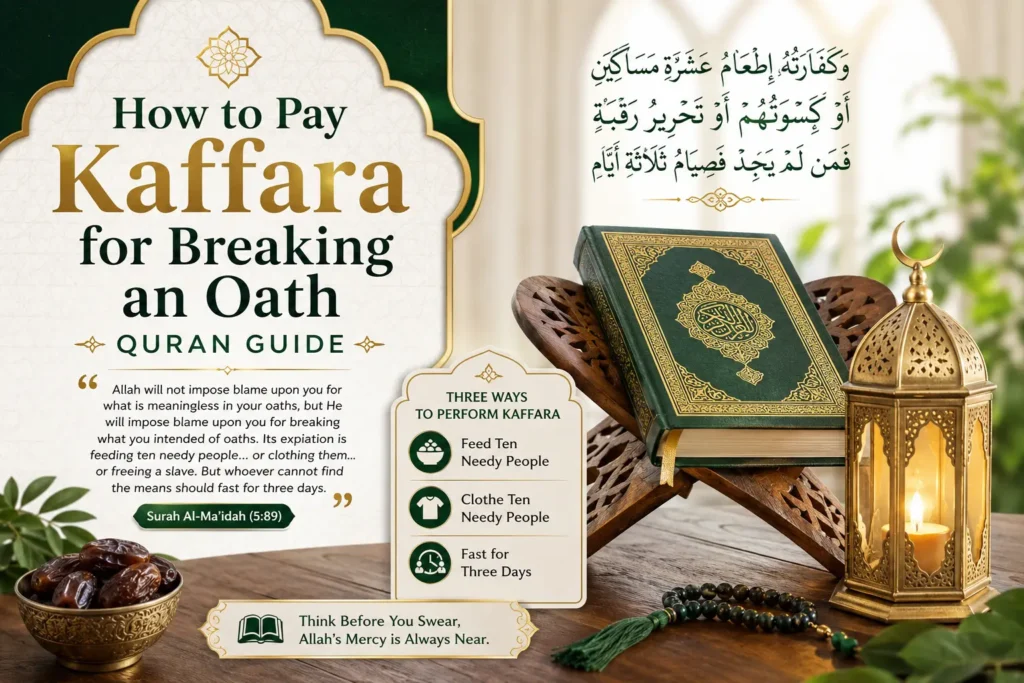
Learn how to pay Kaffarah for breaking an oath according to the Quran. Discover the three Kaffarah options, Quranic evidence, practical examples, common mistakes, and answers to frequently asked questions.
Breaking an oath can leave many Muslims feeling guilty and confused. Understanding the true kaffarah meaning provides clarity when you are unsure how to make amends.
Questions like “Have I committed a sin?”, “Can Allah forgive me?”, and “How do I pay kaffarah for a broken oath?” are very common.
The good news is that Islam is a religion of mercy. Allah knows that people sometimes make promises in anger, sadness, or without thinking. Instead of leaving believers without hope, Allah has clearly explained how to resolve a kaffarah oath so you can seek forgiveness and make things right.
In this complete Quran guide, you’ll learn:
- What expiation for breaking an oath means
- When Kaffarah becomes necessary
- The three ways to pay Kaffarah
- The Quranic evidence
- Real-life examples
- Common mistakes to avoid
- Frequently asked questions
Whether you have already broken an oath or simply want to understand Islamic rulings, this guide will help you with authentic, easy-to-understand information.
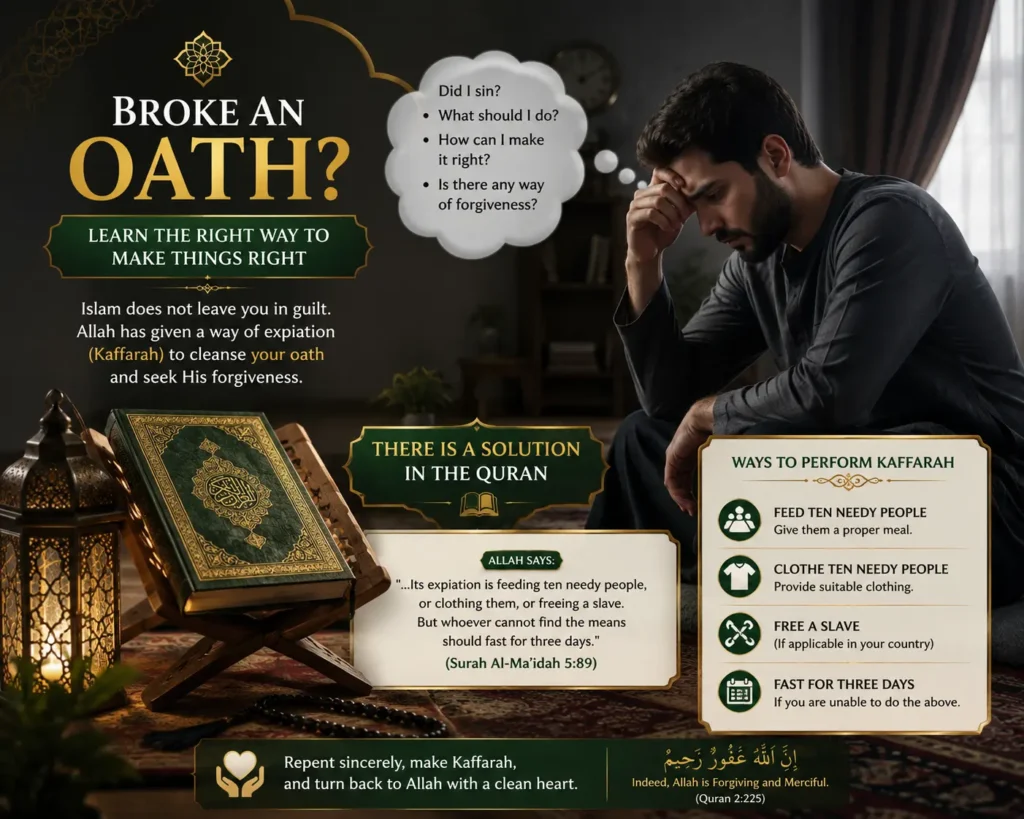
What Is Expiation for a Broken Oath in Islam?
Understanding what is kaffarah in islam begins with its definition. The kaffarah meaning refers to the required penalty prescribed by Allah when resolving a kaffarah for broken oath situations aftebreaking a valid oath (Yameen).
Instead of remaining in sin, Allah has provided believers with a practical way to correct their mistake.
What Does the Quran Say About Breaking an Oath?
When Muslims ask what is the kaffara for breaking an oath, the primary source of guidance is the Holy Quran. Allah explicitly outlines the rules for kaffarah for breaking an oath in Surah Al-Ma’idah:
“Allah will not impose blame upon you for what is meaningless in your oaths, but He will impose blame upon you for breaking what you intended of oaths. Its expiation is feeding ten needy people from the average of what you feed your own families, or clothing them, or freeing a slave. But whoever cannot find the means should fast for three days. That is the expiation for breaking your oaths when you have sworn.”
(Surah Al-Ma’idah 5:89)
This Quranic verse serves as the foundation for calculating and fulfilling the kaffarah for breaking oath commitments properly. It clearly defines:
- when a person becomes accountable, and
- how Kaffarah should be paid.
When Is Kaffarah Required?
Understanding when a kaffarah oath obligation is required helps ensure you fulfill your religious obligations correctly:
- You intentionally swear by Allah.
- You later break that oath.
- The oath was made seriously, not as a casual expression.
Example
“I swear by Allah I will never visit that place again.”
If the person later chooses to visit it, Kaffara becomes due.
When Is Kaffarah NOT Required?
According to Islamic scholars, Kaffarah is generally not required when:
- words are spoken habitually without intention
- someone accidentally says “Wallahi” without meaning it
- an oath is impossible to fulfill from the beginning
- a person forgets unintentionally (scholarly opinions may differ in specific cases)
If you are unsure about your situation, consult a qualified local scholar.
How to Pay Your Oath Expiation Step-by-Step
When you need to pay kaffarah for broken oath, Allah mercifully provides three primary options before fasting.
Option 1: Feed Ten Poor People
This is the most common way.
You should feed ten needy people from the kind of food you normally provide for your own family.
Examples include:
- Rice
- Bread
- Meat
- Lentils
- Dates
- Cooked meals
The goal is to provide a normal, respectable meal—not the cheapest possible food.
Option 2: Provide Clothing to Ten Poor People
Instead of food, you may provide clothing.
Suitable clothing should be sufficient for normal wear according to local customs.
Examples include:
- A complete modest outfit
- A shirt and trousers
- A dress
- Other appropriate garments
Option 3: Free a Slave
The Quran also mentions freeing a slave. Since slavery no longer exists in most parts of the world, this option is generally not applicable today.
If You Cannot Afford Any of These
Allah says:
“…whoever cannot find the means should fast for three days.”
If a person genuinely cannot afford to pay kaffarah through food or clothing, they should fast for three days instead.
Can the Three Days of Fasting Be Separate?
Scholars have differed on whether the three fasts should be consecutive or may be separate.
Many scholars recommend fasting three consecutive days as the safer practice, while some allow them to be separate based on scholarly interpretation. If possible, following the consecutive approach is recommended.
Can You Give Money Instead?
This is one of the most frequently asked questions.
Some scholars permit giving the monetary equivalent if it genuinely benefits the poor, while many others prefer following the wording of the Quran by providing food or clothing directly.
If you are unsure, consult a trusted scholar in your area and follow the opinion you are comfortable acting upon.
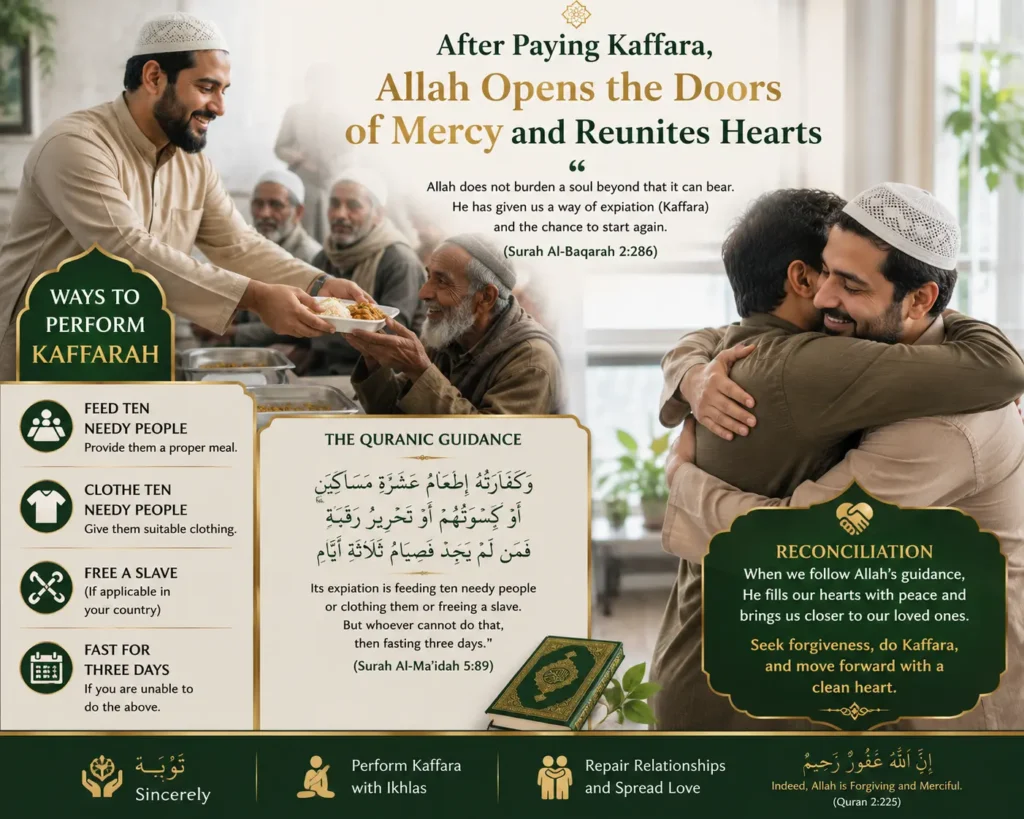
Real-Life Experience 1: A Student’s Question About His Father’s Oath
One day, one of my students came to me with a sincere question.
He said, “My father swore by Allah that he would never visit his sister’s house again after a family disagreement. Now he regrets saying it because he wants to reconcile with her, but he is worried about breaking his oath. What should he do?”
I explained that Islam encourages reconciliation between family members. If maintaining the oath would prevent something good, then it is better to break the oath, seek Allah’s forgiveness, and focus on compensating for the broken promise through the prescribed Kaffarah in Surah Al-Ma’idah (5:89). I encouraged him to tell his father not to let a moment of anger keep him away from family ties when Allah has already provided a way to correct such mistakes.
This reminder brought him peace of mind, and he understood that Allah’s guidance always balances justice with mercy.
Real-Life Experience 2: An Oath Taken on the Quran
Another situation happened within my own family.
A family member became very upset during an argument and placed his hand on the Quran, saying, “I will never speak to him again.”
After some time, he deeply regretted what he had said and wanted to repair the relationship, but he was afraid he had no way back.
I opened the Quran and showed him Surah Al-Ma’idah (5:89), where Allah explains the Kaffarah for breaking an oath. We discussed the verse together, and I explained that Islam values forgiveness, reconciliation, and fulfilling Allah’s commands. Once he understood the ruling, he felt relieved, broke the oath for the sake of restoring family ties, and made arrangements to fulfill his expiation.
That experience reminded our family that Allah’s guidance always leaves the door open for repentance and doing what is right.
Common Mistakes People Make
Avoid these common misunderstandings:
❌ Thinking Allah will never forgive them.
❌ Believing every casual “Wallahi” requires Kaffarah.
❌ Refusing to break an oath even when breaking it would lead to something better and permissible.
❌ Ignoring Kaffarah after intentionally breaking a valid oath.
❌ Delaying Kaffarah unnecessarily without a valid reason.
Quick Reference Table
| Situation | Kaffara Required? |
|---|---|
| Intentional oath broken | ✅ Yes |
| Casual speech without intention | ❌ No |
| Feed ten poor people | ✅ Valid |
| Clothe ten poor people | ✅ Valid |
| Free a slave (where applicable) | ✅ Valid |
| Cannot afford any option | Fast three days |
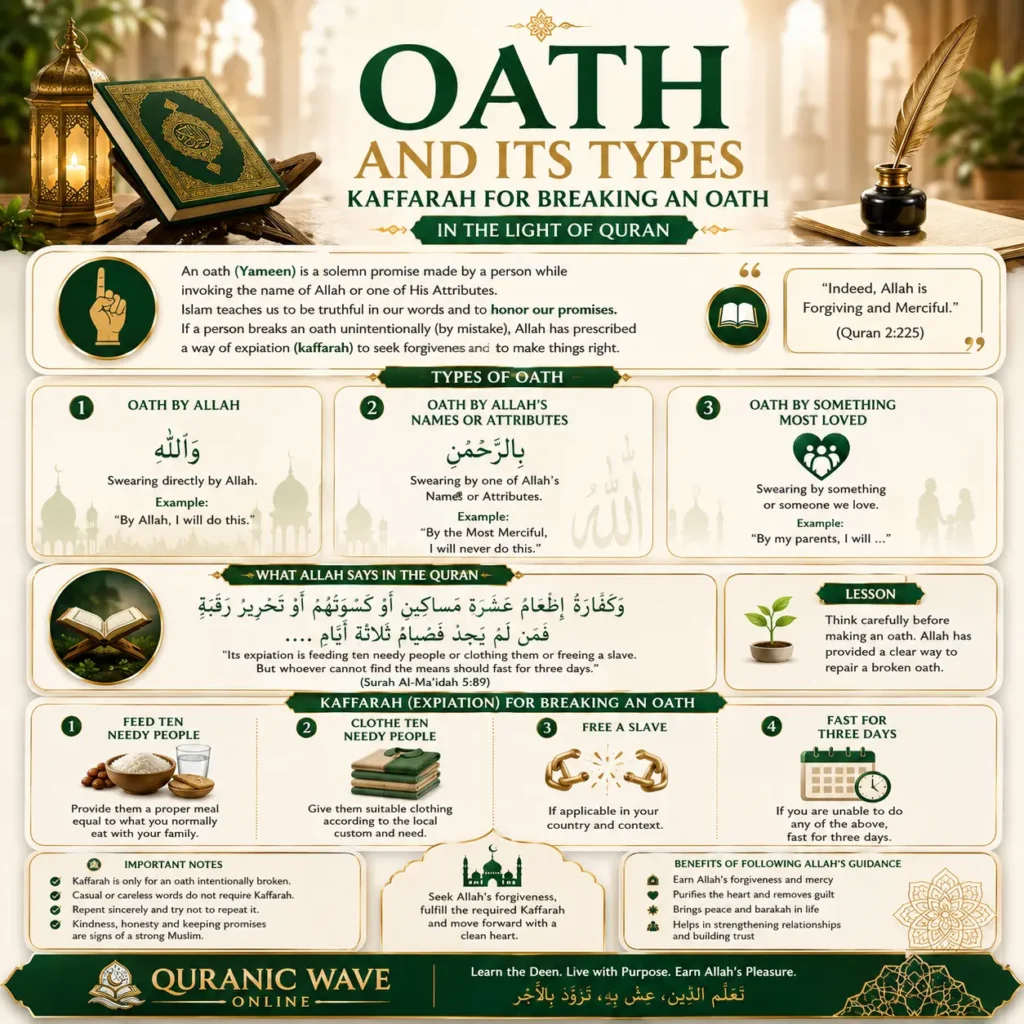
Lessons We Learn from the Quran
Learning about Kaffarah for breaking an oath teaches several valuable spiritual lessons:
- Think carefully before swearing by Allah.
- Avoid making promises in anger.
- Never lose hope in Allah’s mercy.
- Repair family relationships whenever possible.
- Follow Allah’s guidance instead of acting on emotions.
Practical Tips Before Taking an Oath
- Pause before saying “Wallahi.”
- Avoid making absolute promises.
- Control anger before speaking.
- Seek advice when emotions are high.
- Remember that honesty is more important than dramatic promises.
Frequently Asked Questions (FAQ)
Is breaking an oath always a sin?
Breaking a valid oath intentionally requires expiation. However, Allah has provided this expiation so believers can seek His forgiveness and correct their mistake.
Can I pay Kaffarah before redeeming my oath?
The Quran explains Kaffarah as the expiation for a broken oath. If you are considering breaking an oath because doing so is better or more beneficial, consult a qualified scholar regarding the timing in your specific situation.
Can I give money instead of food?
There is scholarly disagreement. Some scholars allow it in certain circumstances, while others prefer providing food or clothing as stated in the Quran.
Can I feed one poor person ten times?
Many scholars hold that the Quran specifies ten needy people, so feeding ten different individuals fulfills the wording of the verse.
Can I break an oath to restore family relationships?
If an oath prevents a good and permissible action—such as reconciling with relatives—Islam encourages doing what is right and then fulfilling the required Kaffarah. This should be done sincerely and in accordance with Islamic guidance.
What if I genuinely cannot afford Kaffarah?
If you truly cannot afford to feed or clothe ten poor people, the Quran instructs you to fast for three days.
Final Thoughts
Understanding how to pay kaffarah for breaking oath obligations helps Muslims respond to mistakes with faith, responsibility, and hope.
Allah does not want hardship for His servants; instead, He provides a clear path to repentance and correction. If you have broken a valid oath, do not despair. Fulfill the Kaffarah prescribed in the Quran, seek Allah’s forgiveness, and move forward with sincerity.
Family disagreements, emotional moments, and impulsive promises happen to everyone. What truly matters is returning to Allah’s guidance and choosing what is right.
If you found this guide helpful, consider sharing it with your family and friends so more people can understand the Quranic ruling on oath expiation. Learning and sharing authentic Islamic knowledge is a rewarding way to benefit others while strengthening your own understanding.