
There are some Arabic words that Muslims hear and use every day, but understanding the true alhamdulillah meaning (الحمد لله) is essential for every believer. In my own journey of studying Islam and teaching others, I have found that this simple phrase carries profound depth and beauty. You may hear someone say it after receiving good news, finishing a meal, answering “How are you?”, recovering from difficulty, or simply reflecting on Allah’s blessings.
But what does Alhamdulillah really mean? Is it only a way of saying “Thank God in Arabic”? How should you pronounce it, when should you say it, and what does the Qur’an and Sunnah teach about it?
In this guide, I’ll explain the meaning of Alhamdulillah, its place in the Qur’an and Hadith, its pronunciation, everyday usage, and several authentic supplications and expressions connected with praising Allah.
What Does Alhamdulillah Mean?
Quick Overview:
-
Alhamdulillah in Arabic: الحمد لله
-
Alhamdulillah meaning in English: “All praise is due to Allah” or “Praise belongs to Allah.”
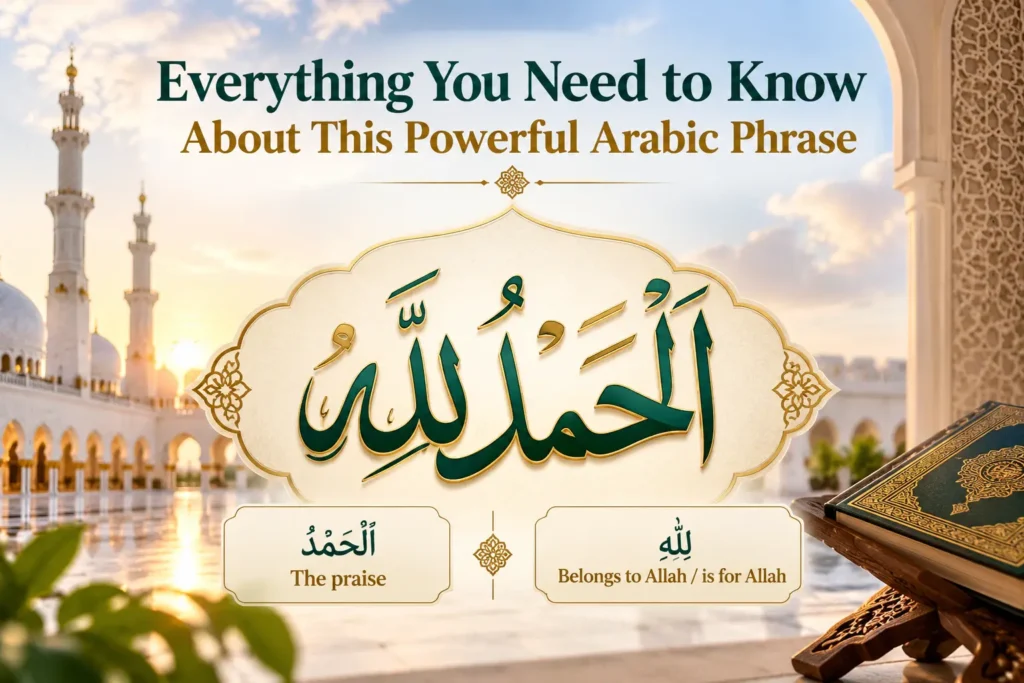
Alhamdulillah (الحمد لله) literally conveys the meaning of “Praise belongs to Allah” or “All praise is for Allah.” It is also commonly translated as “Praise be to God” or “Thank God,” although the fuller Islamic meaning includes both praise and gratitude.
The phrase consists of:
| Arabic | Meaning |
|---|---|
| الْحَمْدُ | The praise |
| لِلَّهِ | Belongs to Allah / is for Allah |
| الحمد لله | All praise is for Allah |
The word hamd carries a broader meaning than simple thanks. It involves praising Allah for who He is, His perfect attributes, and His blessings.
That is why Alhamdulillah can be said when something pleasant happens, but it is also an expression of worship and recognition of Allah at all times.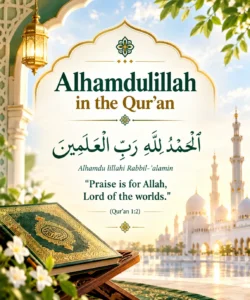
The phrase appears at the very beginning of the Qur’an in Surah Al-Fatihah:
الْحَمْدُ لِلَّهِ رَبِّ الْعَالَمِينَ
Alhamdu lillahi Rabbil-‘alamin
“Praise is for Allah, Lord of the worlds.” (Qur’an 1:2)
How Do You Pronounce Alhamdulillah?
A common Arabic pronunciation is:
Alhamdulillah
The Haa (ح) is important. It is the Arabic letter ح, a deeper, breathy “h” sound that is different from the ordinary English “h.”
A simple learner-friendly pronunciation guide is:
al-ham-du lil-lah
Arabic pronunciation can vary slightly depending on recitation style and connected speech, but the Arabic spelling should remain:
الحمد لله
When learning the phrase, pay attention to the Arabic letter Haa (ح) rather than replacing it with a completely ordinary English “h” sound.
Is Alhamdulillah the Same as “Thank God”?
Not exactly.
In everyday English, “Thank God” often expresses relief or gratitude. Alhamdulillah can certainly express gratitude, but its meaning is richer.
It acknowledges that praise belongs to Allah whether a person is experiencing ease, receiving a blessing, or simply recognizing Allah’s greatness.
For this reason, translating it simply as “Thank God in Arabic” can be useful for beginners, but it does not capture the complete meaning.
A closer translation is:
“All praise is due to Allah.”
Alhamdulillah in the Qur’an
The Qur’an repeatedly teaches believers to praise Allah.
The most famous example is Surah Al-Fatihah, which begins with Alhamdulillah Rabbil-‘Alamin.
The Qur’an also describes the people of Paradise saying:
الْحَمْدُ لِلَّهِ الَّذِي أَذْهَبَ عَنَّا الْحَزَنَ
“Praise be to Allah, Who has removed sorrow from us.” (Qur’an 35:34)
Another important verse says:
وَقُلِ الْحَمْدُ لِلَّهِ
“And say, ‘Praise be to Allah.’” (Qur’an 27:93)
The Qur’an also commands:
وَقُلِ الْحَمْدُ لِلَّهِ الَّذِي لَمْ يَتَّخِذْ وَلَدًا
“And say, ‘Praise be to Allah, Who has never taken a child.’” (Qur’an 17:111)
These verses show that praising Allah is not limited to one particular situation.
The Power of Gratitude: How Saying Alhamdulillah Unlocks Allah’s Blessings (Barakah)
Saying Alhamdulillah is a simple and powerful way to thank Allah. When you express gratitude for your blessings, you invite more barakah (blessings) into your life. Praise Him for your health, family, food, and quiet everyday mercies.
Gratitude turns whatever you have into enough. Allah promises in Surah Ibrahim that when you show thanks, He will surely give you more.
Why Is Alhamdulillah Important in Islam?
The phrase combines recognition of Allah with gratitude.
The Prophet Muhammad ﷺ taught that Alhamdulillah is among the great words of remembrance. A hadith recorded in Sahih Muslim states that “Al-hamdu lillah” fills the scales, while SubhanAllah and Alhamdulillah together fill what is between the heavens and the earth.
Another authentic narration states that the most beloved words to Allah include:
SubhanAllah, Alhamdulillah, La ilaha illallah, and Allahu Akbar.
This makes Alhamdulillah much more than an ordinary Arabic phrase. It is part of dhikr, or remembering Allah.
Note for Readers:
Seeking Allah’s pardon goes hand in hand with praising Him. If you would like to learn about the specific supplications for seeking pardon or explore how asking for forgiveness transforms daily life, check out our guide on the powerful duas for forgiveness (istighfar) and the miracles of istighfar.
When Should You Say Alhamdulillah?
There is no need to restrict this phrase to one situation. It can naturally be used when praising and thanking Allah.

1. After Receiving a Blessing
If you receive good news, complete an important task, or experience something that makes you grateful, saying Alhamdulillah is a natural expression of gratitude.
2. When Someone Asks “How Are You?”
A Muslim may answer:
“Alhamdulillah, I’m well.”
This is a common everyday use. It communicates gratitude to Allah while answering the question.
It should not be treated as a fixed Islamic greeting or a mandatory response. It is simply a meaningful way to express gratitude.
3. After Eating or Drinking
The Prophet ﷺ taught that Allah is pleased with a servant who praises Him after eating or drinking. Sahih Muslim records that the servant says Al-Hamdu lillah after eating a meal or drinking.
So Alhamdulillah naturally becomes part of a Muslim’s daily routine around food and drink.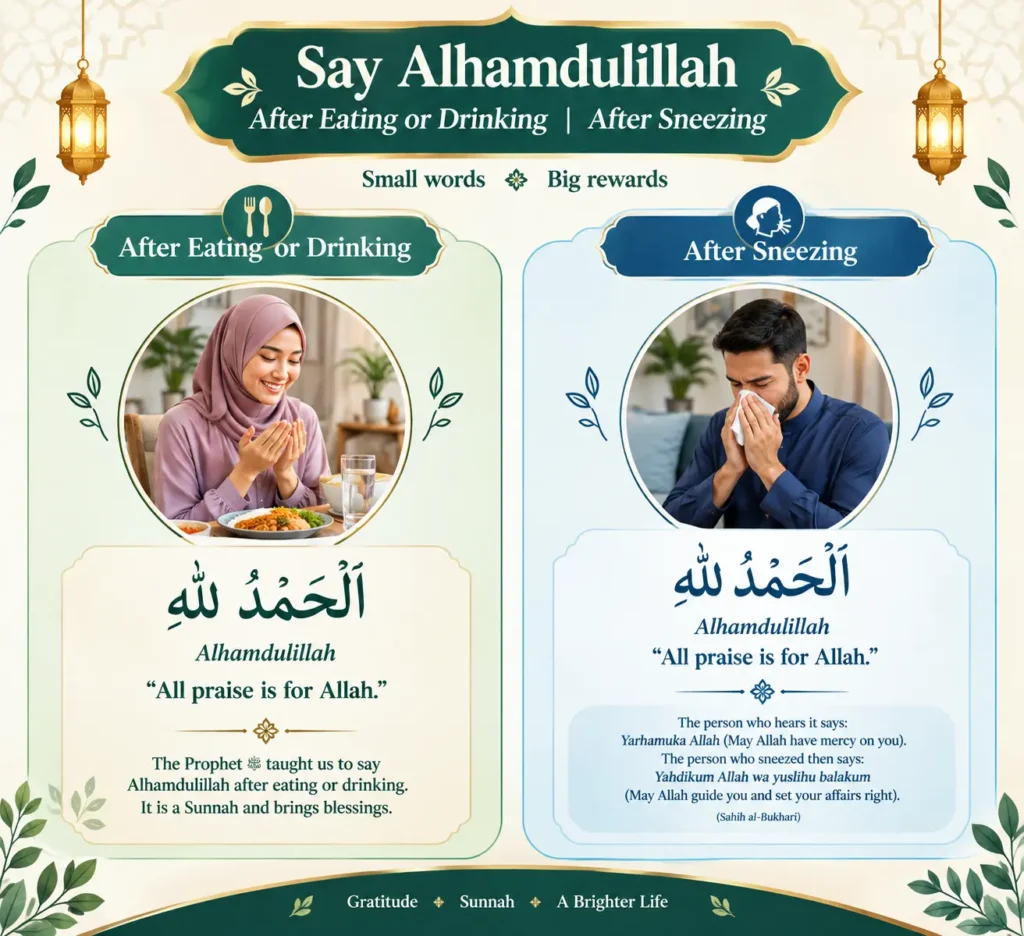
4. After Sneezing
The Sunnah also connects Alhamdulillah with sneezing.
When a Muslim sneezes, they say:
الْحَمْدُ لِلَّهِ
Alhamdulillah
The person who hears it responds:
يَرْحَمُكَ اللَّهُ
Yarhamuka Allah — “May Allah have mercy on you.”
The person who sneezed then responds:
يَهْدِيكُمُ اللَّهُ وَيُصْلِحُ بَالَكُمْ
Yahdikumullahu wa yuslihu balakum — “May Allah guide you and set your affairs right.”
This sequence is reported in Sahih al-Bukhari.
5. During Salah
Praising Allah is also built into salah.
After the imam says:
سَمِعَ اللَّهُ لِمَنْ حَمِدَهُ
the worshippers say:
رَبَّنَا وَلَكَ الْحَمْدُ
Rabbana wa lakal-hamd
“Our Lord, and to You is the praise.”
This wording is established in authentic hadith.
Another reported wording is:
اللَّهُمَّ رَبَّنَا وَلَكَ الْحَمْدُ، مِلْءَ السَّمَاوَاتِ وَمِلْءَ الْأَرْضِ وَمِلْءَ مَا شِئْتَ مِنْ شَيْءٍ بَعْدُ
Meaning: “O Allah, our Lord, to You is the praise, filling the heavens, filling the earth, and filling whatever else You will.”
This wording is reported from the Prophet ﷺ in Sunan an-Nasa’i.
Authentic Duas and Supplications Containing Praise of Allah
The Qur’an and Sunnah contain several beautiful expressions that teach Muslims how to praise Allah.
Praise in Surah Al-Fatihah
الْحَمْدُ لِلَّهِ رَبِّ الْعَالَمِينَ
“Praise is for Allah, Lord of the worlds.”
Source: Qur’an 1:2.
Praise After Relief From Sorrow
الْحَمْدُ لِلَّهِ الَّذِي أَذْهَبَ عَنَّا الْحَزَنَ ۖ إِنَّ رَبَّنَا لَغَفُورٌ شَكُورٌ
“Praise be to Allah, Who has removed sorrow from us. Indeed, our Lord is Most Forgiving, Most Appreciative.”
Source: Qur’an 35:34.
Praise Before Sleeping
The Prophet ﷺ taught:
الْحَمْدُ لِلَّهِ الَّذِي أَطْعَمَنَا وَسَقَانَا وَكَفَانَا وَآوَانَا، فَكَمْ مِمَّنْ لَا كَافِيَ لَهُ وَلَا مُؤْوِيَ
“Praise is due to Allah Who fed us, gave us drink, sufficed us, and gave us shelter, for how many have none to suffice them or shelter them.”
Source: Sahih Muslim 2715.
Praise When Wearing Clothing
A reported supplication says:
الْحَمْدُ لِلَّهِ الَّذِي كَسَانِي هَذَا الثَّوْبَ وَرَزَقَنِيهِ مِنْ غَيْرِ حَوْلٍ مِنِّي وَلَا قُوَّةٍ
“Praise is to Allah Who has clothed me with this garment and provided it for me without any power or strength from me.”
This is reported in the collections referenced by Hisn al-Muslim, including al-Bukhari and Muslim.
Praise With Abundant, Good and Blessed Praise
After rising from bowing, one reported wording is:
رَبَّنَا وَلَكَ الْحَمْدُ حَمْدًا كَثِيرًا طَيِّبًا مُبَارَكًا فِيهِ
“Our Lord, to You is praise—abundant, good and blessed praise.”
It is reported in Sahih al-Bukhari and cited in Hisn al-Muslim.
Alhamdulillah vs. Inshallah vs. Mashallah vs. Bismillah
These Arabic and Islamic phrases are related to everyday Muslim speech, but they have different meanings.
| Phrase | Arabic | Basic meaning | Common use |
|---|---|---|---|
| Alhamdulillah | الحمد لله | All praise is for Allah | Gratitude and praise |
| Inshallah | إن شاء الله | If Allah wills | Future plans |
| Mashallah | ما شاء الله | What Allah has willed | Admiration or acknowledging a blessing |
| Bismillah | بسم الله | In the name of Allah | Beginning an action |
| Shokran | شكراً | Thank you | General Arabic thanks |
| Yarhamuk Allah | يرحمك الله | May Allah have mercy on you | Response to a sneeze |
| Ya Rab | يا رب | O Lord | Calling upon Allah |
These phrases should not be treated as interchangeable. Each has its own linguistic meaning and context.
Is Alhamdulillah Only Used by Muslims?
Alhamdulillah is an Arabic expression meaning praise belongs to Allah, and it is especially prominent in Islamic worship and Muslim daily speech.
Arabic-speaking Christians and others can also use expressions involving al-hamd lillah in Arabic because the words themselves are Arabic. However, within Islam, Alhamdulillah has a particularly important place because of its presence in the Qur’an and Sunnah.
Common Mistakes About Alhamdulillah
A few simple points can prevent confusion:
- Do not treat Alhamdulillah as meaning only “thank you.” It expresses praise and gratitude to Allah.
- Do not confuse it with Bismillah. Bismillah is “In the name of Allah.”
- Do not confuse it with Inshallah. Inshallah refers to something Allah wills in the future.
- Do not assume it is only for good news. The phrase is fundamentally an expression of praise to Allah.
- Learn the Arabic pronunciation carefully. The letter ح has a distinct Arabic sound.
How to Make Alhamdulillah Part of Daily Life
Rather than repeating the phrase mechanically, connect it with something you genuinely recognize as a blessing.
You can build it into ordinary moments:
- After eating or drinking.
- When answering how you are.
- After receiving good news.
- After completing something difficult.
- When noticing a blessing you normally overlook.
- After sneezing.
- During salah.
- When reflecting on Allah’s mercy and provision.
This turns an ordinary daily Arabic phrase into a conscious act of remembrance.
My Daily Morning Routine: Starting the Day with Gratitude
Every morning, right after performing the Fajr prayer, I make it a point to recite Alhamdulillah 100 times. Praise belongs to Allah for granting me another day of life, along with fresh opportunities to do good deeds and enjoy His endless blessings.
Starting my morning with this simple dhikr grounds my mindset in gratitude before the busyness of the day begins. Pausing to recognize Allah’s gifts first thing after waking fills my day with peace, focus, and barakah.
Frequently Asked Questions
What does Alhamdulillah mean?
Alhamdulillah (الحمد لله) means “All praise is for Allah” or “Praise belongs to Allah.” It expresses praise and gratitude to Allah.
What is Alhamdulillah in English?
The closest common translation is “All praise is due to Allah” or “Praise be to Allah.” “Thank God” communicates part of the meaning but is less complete.
How do you say Thank God in Arabic?
A common Islamic expression is Alhamdulillah (الحمد لله). It means that praise and gratitude belong to Allah.
Can I say Alhamdulillah when someone asks how I am?
Yes. Saying Alhamdulillah when answering “How are you?” is a common expression of gratitude. It is not a required fixed response.
What is the difference between Alhamdulillah and Shokran?
Alhamdulillah is praise and gratitude directed to Allah. Shokran (شكراً) generally means “thank you” in Arabic and is normally used when thanking another person.
What should I say after someone sneezes?
If the person says Alhamdulillah, the Sunnah response is Yarhamuka Allah. The person who sneezed then responds with Yahdikum Allah wa yuslihu balakum.
Is Alhamdulillah mentioned in the Qur’an?
Yes. The phrase appears in several Qur’anic passages, most famously at the beginning of Surah Al-Fatihah: Alhamdulillahi Rabbil-‘Alamin.
Final Thoughts
I hope this guide helps you connect more deeply with the beauty and weight of saying Alhamdulillah. In my experience, pausing to reflect on this phrase transforms it from a routine response into a powerful act of heart-centered gratitude.
Whether you say it in times of ease or hardship, remembering that all praise belongs to Allah brings instant peace to the heart. I invite you to carry this mindfulness into your daily dhikr and notice the barakah it brings to your life.
Keep learning the meanings behind the Arabic phrases you use every day. Understanding the words can make your daily Arabic phrases, dhikr, duas, and acts of worship more conscious and meaningful.