
Want to know how to teach Quran to kids the fun way? Teaching children the Quran is one thing, but helping them truly love learning it is something much deeper.
A child may be able to read Arabic letters, memorize short surahs, and attend Quran classes regularly, yet still see Quran learning as another task they have to complete.
The goal should be more than finishing pages or memorizing a certain number of surahs. We want our children to develop a warm connection with the words of Allah and gradually understand that the Quran is guidance for their everyday lives.
The Prophet Muhammad ﷺ encouraged Muslims to learn and teach the Quran. He said:
“The best of you are those who learn the Quran and teach it.”
(Sahih al-Bukhari)
As parents, we can make Quran learning a positive part of family life through encouragement, creativity, consistency, and love. Here are 10 creative ways to help your kids love learning the Quran without turning every lesson into a struggle.
1. Make Quran Time a Happy Family Routine
-
Begin with Bismillah together to set a peaceful intention.
-
Read a short portion side-by-side.
-
Practice pronunciation gently without harsh corrections.
-
Explain one simple meaning that connects to their world.
-
End with genuine encouragement and praise.
“And We have certainly made the Quran easy for remembrance, so is there anyone who will remember?”(Quran 54:17)
2. Give Children Choice and Ownership Over Their Quran Time
- What to read: “Would you like to start with Surah Al-Falaq or Surah An-Nas today?”
-
How much to read: “Should we aim for three verses or five verses today?”
-
Which order to follow: “Would you like to practice reciting first, or should we go over the meanings first?”
-
Where to start: “Which page or line would you like us to begin with today?”

3. Connect Quran Learning With Everyday Life
One of the most effective ways to make the Quran meaningful is to show children that its guidance is connected to real life.
Suppose your child learns about gratitude. Ask:
“What is one thing Allah gave you today that you are thankful for?”
If you are studying kindness, discuss how your child can speak gently to a sibling.
If you are learning about patience, talk about what happens when a child loses a game or has to wait for something.
The Quran teaches:
“Indeed, Allah commands justice and good conduct…”
(Quran 16:90)
Rather than treating Quranic lessons as information that stays inside a notebook, help your child recognize them in everyday situations.
This is particularly useful for Islamic parenting and Quran education, because children gradually learn that the Quran is not only something they recite. It is guidance for how they think, speak, behave, and make choices.
4. Fun Games to Teach Quran to Kids
Memorizing Quran can sometimes feel difficult for children, especially when they are asked to repeat the same verses many times.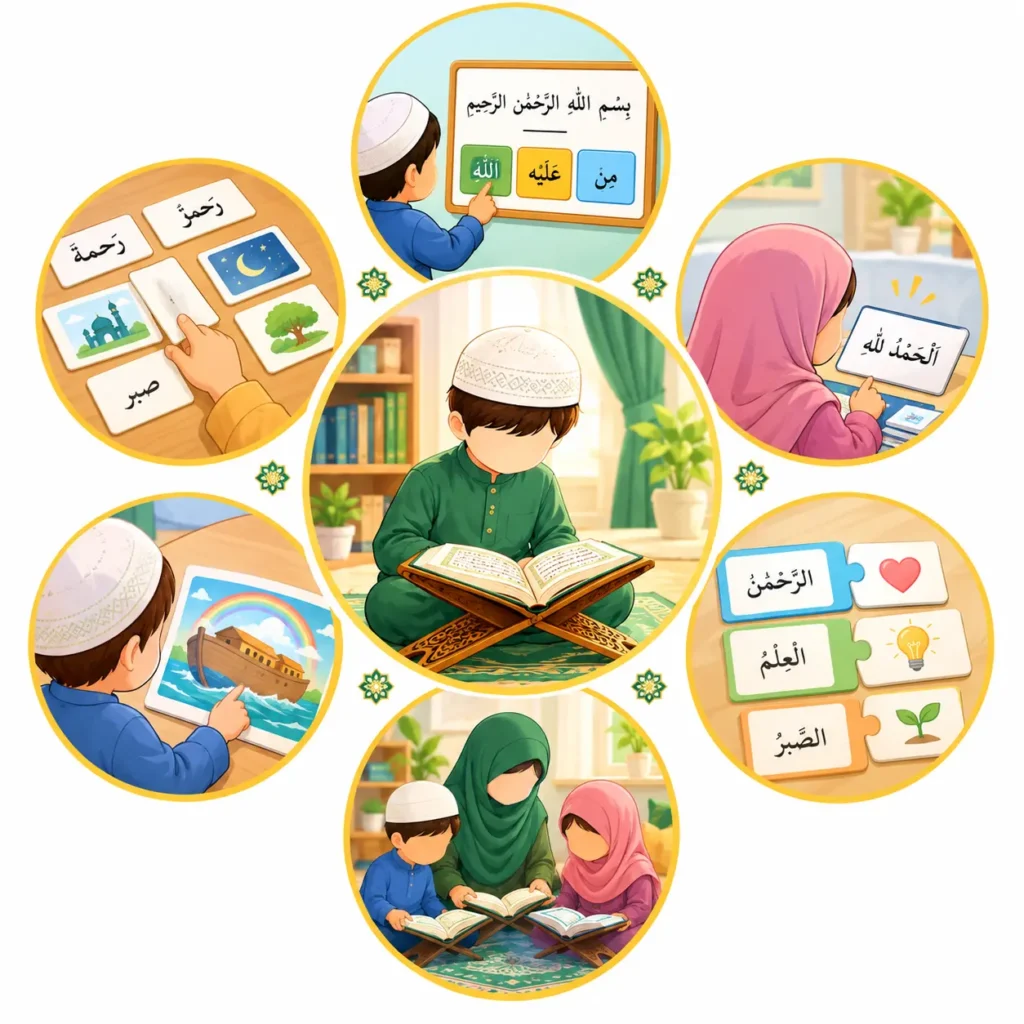
Games can make revision more engaging without making the Quran itself a source of entertainment.
Try activities such as:
Missing Word Game
Recite a familiar verse and pause before an important word. Let your child complete it.
Surah Detective
After reading a short surah, ask:
- What is this surah about?
- Which words did you recognize?
- What lesson did you notice?
Verse Matching
Write simple words or meanings on cards and have your child match related cards.
Family Revision Challenge
Choose a short surah everyone knows and take turns reciting it.
The purpose is not to turn Quran recitation into a competition. The goal is to make revision active and enjoyable.
5. Teach the Meaning, Not Just the Words
A child may memorize a surah without understanding what it says. Even a very young child can benefit from simple explanations.
For example, when learning Surah Al-Ikhlas, explain in age-appropriate language that Allah is One and unlike His creation.
When learning Surah Al-Falaq, explain that Muslims ask Allah for protection from different forms of harm.
When teaching Surah An-Nas, discuss seeking Allah’s protection from evil thoughts and whispers.
Allah says:
“This is a blessed Book which We have revealed, so follow it and be mindful of Allah that you may receive mercy.”
(Quran 6:155)
Understanding gives children a reason to remember what they are learning.
Parents do not need to give lengthy lectures. One clear idea connected to a child’s world can be enough.
6. Use Quran Stories to Teach Kids
Children naturally respond to stories.
The Quran contains stories of prophets and earlier communities that teach lessons about faith, patience, courage, repentance, gratitude, and obedience to Allah.
When teaching a story, avoid turning it into a long lecture. Instead, ask questions.
For example:
“What do you think Prophet Nuh (AS) felt when people rejected his message?”
“What can we learn from Prophet Yusuf (AS) when someone treats us unfairly?”
“What did Prophet Ibrahim (AS) teach us about trusting Allah?”
Allah says:
“Indeed, in their stories is a lesson for those of understanding.”
(Quran 12:111)
Want to help your child master Quran memorization and understanding ?Explore interactive 1-on-1 lessons tailored for young learners with QuranicWave.
7. Let Children See You Loving the Quran
Children learn enormously from what they observe.
If parents constantly tell children to read the Quran but rarely allow them to see Quran recitation or study taking place at home, the message may feel like a rule rather than a family value.
Let your children see you:
- Reading the Quran quietly.
- Listening attentively to recitation.
- Reflecting on an ayah.
- Making dua.
- Learning something new.
- Speaking respectfully about the Quran.
You do not need to make a formal demonstration of it.
Sometimes a child simply sitting beside a parent while the parent reads Quran can create a powerful association: “The Quran is something my family loves.”
The Prophet ﷺ said:
“The example of a believer who recites the Quran is that of a citron which smells good and tastes good…”
(Sahih al-Bukhari; Sahih Muslim)
Your own relationship with the Quran can influence the atmosphere in which your child learns.
For more practical tips on nurturing your child’s spiritual growth, read our detailed Islamic Parenting Guide for Raising Muslim Children .
8. Create a Special Quran Learning Space
A dedicated space can make Quran time feel special.
It does not need to be expensive. A small corner of the home can include:
- A Quran stand.
- A child-friendly Quran or reading book.
- A notebook for new Arabic words.
- Pencils and educational cards.
- A small shelf for Islamic books.
- A comfortable prayer mat.
Keep the space clean and peaceful.
For younger children, you might create a simple Quran learning chart where they can record what they have practiced. Focus on effort and consistency rather than rewarding only the number of pages memorized.
A child can learn to associate that corner with calmness, discovery, and family time.
9. Celebrate Effort and Progress Instead of Demanding Perfection
-
Acknowledge Small Milestones: When a child completes the Qaida or successfully masters a complex Tajweed rule and applies it regularly, I make sure to praise and admire their hard work. Offering a small gift or words of encouragement builds their motivation to keep going.
-
Mark Major Achievements: Reaching big milestones—such as completing their first Para (Juz) or finishing the entire Quran—deserves a special celebration. Presenting them with gift cards, presents, or a small family gathering shows them how important their achievement truly is.
-
Remind Them of Their Journey: When a child feels discouraged by a difficult lesson, I gently remind them of their early days: “Remember when you couldn’t even pronounce the letters? Look at you now—subhanAllah, you are reading full lines and pages on your own!”
-
Connect Progress to Allah’s Help: I always remind children that their growth happened because Allah saw them putting in sincere effort. When they work hard and try their best, Allah blesses them with ease, allowing them to read fluently by themselves (Alhamdulillah).
“The one who is proficient in the Quran will be with the noble and obedient scribes, and the one who reads the Quran and stumbles while it is difficult for him will have two rewards.”(Sahih al-Bukhari & Sahih Muslim)
10. Make Dua Together for a Strong Relationship With the Quran
Parents naturally want their children to become people of faith, good character, and beneficial knowledge. Along with teaching and encouraging them, make dua for them.
One beautiful Quranic supplication is:
رَبِّ اجْعَلْنِي مُقِيمَ الصَّلَاةِ وَمِن ذُرِّيَّتِي ۚ رَبَّنَا وَتَقَبَّلْ دُعَاءِ
Rabbi-j‘alni muqimas-salati wa min dhurriyyati rabbana wa taqabbal du‘a.
“My Lord, make me an establisher of prayer, and [many] from my descendants. Our Lord, and accept my supplication.”
(Quran 14:40)
Although this verse specifically mentions establishing prayer, it beautifully reflects a parent’s concern for the faith and worship of their children.
Parents can also make personal dua for their children’s love of the Quran, understanding, good character, and steadfastness.
A Simple Weekly Quran-Learning Plan for Children
You do not need a complicated timetable. A simple plan can look like this:
| Day | Quran Activity |
|---|---|
| Monday | New verses |
| Tuesday | Memorization practice |
| Wednesday | Quran meaning |
| Thursday | Revision game |
| Friday | Quran story and family discussion |
| Saturday | Listening and recitation |
| Sunday | Review and relaxed family reading |
The schedule can be adjusted according to your child’s age, schoolwork, attention span, and Quran level.
Consistency matters more than creating an exhausting routine.
What If My Child Does Not Want to Learn Quran?
This is a common parenting challenge.
First, try to understand why your child is resisting.
Is the lesson too long? Is the material too difficult? Is the teacher overly strict? Is the child tired after school? Are they struggling with Arabic pronunciation? Do they feel embarrassed about making mistakes?
Instead of immediately increasing pressure, identify the obstacle.
You can then make a small adjustment:
- Shorten the session.
- Change the learning activity.
- Review easier material.
- Introduce a different teaching method.
- Speak with the Quran teacher.
- Add more listening and storytelling.
- Give the child a short break before learning.
The objective is not simply to make a child sit quietly with a Quran. It is to gradually develop love, respect, understanding, and consistency.
How Parents Can Make Quran Learning Last
A child’s relationship with the Quran develops over years.
Avoid expecting dramatic results after a few weeks. Some children memorize quickly, while others need more repetition. Some enjoy recitation, while others first become interested through stories or meanings.
Focus on building habits that can continue as children grow:
- Keep Quran visible and respected in the home.
- Read regularly as a family.
- Encourage questions.
- Explain meanings simply.
- Praise sincere effort.
- Correct mistakes kindly.
- Choose qualified Quran teachers.
- Connect Quranic guidance with everyday behavior.
- Make dua for your children.
- Be patient with their individual learning pace.
Allah says:
“And say, ‘My Lord, increase me in knowledge.’”
(Quran 20:114)
This short dua can become part of a family’s learning culture.
Frequently Asked Questions About Helping Children Love the Quran
How can I make Quran learning fun for my child?
Use age-appropriate activities such as Quran stories, listening exercises, vocabulary games, verse completion, drawing related concepts, and family revision. Keep the activities respectful and focused on learning rather than turning Quran recitation itself into entertainment.
What age should children start learning the Quran?
There is no single age that works for every child. Parents can introduce children to listening, simple Arabic letters, short surahs, and Islamic stories according to their development and readiness. Early positive exposure can help establish familiarity with the Quran.
Should I force my child to memorize the Quran?
Children need structure and consistent expectations, but harsh pressure can make learning unpleasant. A better approach is to combine routine with encouragement, suitable goals, patience, and understanding of the child’s learning needs.
How can I help my child understand Quranic verses?
Start with short, age-appropriate explanations. Connect the lesson with everyday experiences and ask simple questions. For detailed tafsir, use reliable scholarly resources and explanations appropriate for your child’s age.
What should parents do when a child keeps forgetting memorized surahs?
Forgetting can happen during memorization. Return to regular revision instead of simply adding more new material. Short, frequent review sessions can help strengthen previously memorized portions.