

What Are the 6 Kalimas in Islam?
The six Kalimas are traditional Islamic declarations and supplications commonly taught in South Asian Muslim communities. They help learners understand fundamental concepts of Islamic faith, including Tawheed (the oneness of Allah), the Shahadah (testimony of faith), repentance, and remembrance of Allah.
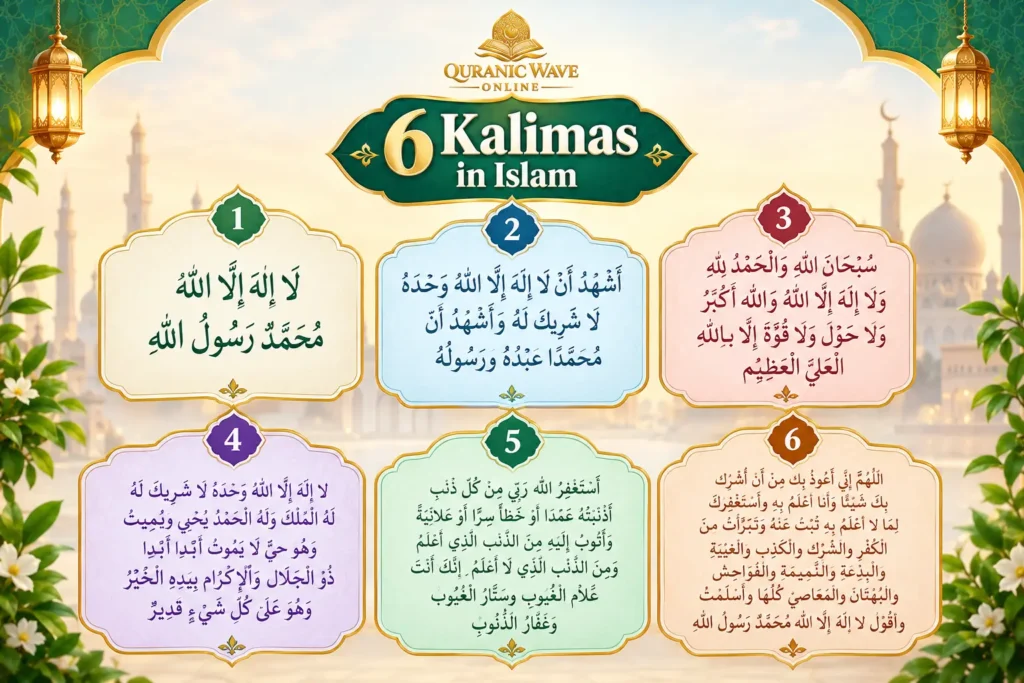
The six Kalimas are:
- First Kalima: Kalima Tayyibah
- Second Kalima: Kalima Shahadah
- Third Kalima: Kalima Tamjeed
- Fourth Kalima: Kalima Tawheed
- Fifth Kalima: Kalima Astaghfar
- Sixth Kalima: Kalima Radd-e-Kufr
It is important to understand that the six Kalimas are not presented as one universally fixed set of six declarations in the Quran. Rather, this collection is a traditional teaching aid, and wording can vary slightly between educational sources.
1. First Kalima: Kalima Tayyibah
The First Kalima expresses the central belief in the oneness of Allah and the prophethood of Muhammad ﷺ.
Arabic:
لَا إِلَٰهَ إِلَّا اللَّهُ مُحَمَّدٌ رَسُولُ اللَّهِ
Transliteration: La ilaha illallahu Muhammadur Rasulullah.
English Translation: There is no god worthy of worship except Allah, and Muhammad is the Messenger of Allah.
Explanation:
This Kalima teaches Muslims to worship Allah alone and recognize Prophet Muhammad ﷺ as His Messenger. It expresses the foundation of Islamic belief and reminds believers to direct their worship, devotion, and ultimate trust toward Allah.
2. Second Kalima: Kalima Shahadah
The Second Kalima expands the testimony of faith by declaring Allah’s oneness and the prophethood of Muhammad ﷺ.
Arabic:
أَشْهَدُ أَنْ لَا إِلَٰهَ إِلَّا اللَّهُ وَحْدَهُ لَا شَرِيكَ لَهُ وَأَشْهَدُ أَنَّ مُحَمَّدًا عَبْدُهُ وَرَسُولُهُ
Transliteration: Ashhadu an la ilaha illallahu wahdahu la sharika lahu, wa ashhadu anna Muhammadan abduhu wa rasuluhu.
English Translation: I bear witness that there is no god worthy of worship except Allah alone, without any partner, and I bear witness that Muhammad is His servant and Messenger.
Explanation:
This Kalima emphasizes sincere belief in Allah’s uniqueness. It also recognizes Prophet Muhammad ﷺ as both the servant and Messenger of Allah. The declaration of faith is central to a Muslim’s religious identity.
3. Third Kalima: Kalima Tamjeed
The Third Kalima glorifies Allah and acknowledges His perfection, greatness, and power.
Arabic:
سُبْحَانَ اللَّهِ وَالْحَمْدُ لِلَّهِ وَلَا إِلَٰهَ إِلَّا اللَّهُ وَاللَّهُ أَكْبَرُ وَلَا حَوْلَ وَلَا قُوَّةَ إِلَّا بِاللَّهِ الْعَلِيِّ الْعَظِيمِ
Transliteration: Subhanallahi walhamdu lillahi wa la ilaha illallahu wallahu akbar, wa la hawla wa la quwwata illa billahil Aliyyil Azeem.
English Translation: Glory be to Allah, all praise belongs to Allah, there is no god worthy of worship except Allah, Allah is the Greatest, and there is no power or strength except through Allah, the Most High, the Most Great.
Explanation:
This Kalima combines praise, glorification, and acknowledgment of Allah’s greatness. It reminds believers that all strength and ability ultimately depend on Allah. Reciting these words can also encourage gratitude and humility.
4. Fourth Kalima: Kalima Tawheed
The Fourth Kalima focuses on Allah’s absolute oneness and His sovereignty over everything.
Arabic:
لَا إِلَٰهَ إِلَّا اللَّهُ وَحْدَهُ لَا شَرِيكَ لَهُ لَهُ الْمُلْكُ وَلَهُ الْحَمْدُ يُحْيِي وَيُمِيتُ وَهُوَ حَيٌّ لَا يَمُوتُ أَبَدًا أَبَدًا ذُو الْجَلَالِ وَالْإِكْرَامِ بِيَدِهِ الْخَيْرُ وَهُوَ عَلَىٰ كُلِّ شَيْءٍ قَدِيرٌ
Transliteration: La ilaha illallahu wahdahu la sharika lahu, lahul mulku wa lahul hamdu, yuhyi wa yumitu, wa huwa hayyun la yamutu abadan abada, dhul-jalali wal-ikram, biyadihil khayr, wa huwa ala kulli shay’in qadeer.
English Translation: There is no god worthy of worship except Allah alone, without any partner. His is the dominion and His is all praise. He gives life and causes death, and He is Ever-Living and never dies. He is the Possessor of Majesty and Honor. All good is in His hand, and He has power over everything.
Explanation:
This declaration teaches that Allah is the ultimate owner and ruler of creation. He gives life, causes death, and possesses complete power. It encourages Muslims to recognize His authority and depend on Him.
5. Fifth Kalima: Kalima Astaghfar
The Fifth Kalima is a declaration of repentance and a request for Allah’s forgiveness.
Arabic:
أَسْتَغْفِرُ اللَّهَ رَبِّي مِنْ كُلِّ ذَنْبٍ أَذْنَبْتُهُ عَمَدًا أَوْ خَطَأً سِرًّا أَوْ عَلَانِيَةً وَأَتُوبُ إِلَيْهِ مِنَ الذَّنْبِ الَّذِي أَعْلَمُ وَمِنَ الذَّنْبِ الَّذِي لَا أَعْلَمُ إِنَّكَ أَنْتَ عَلَّامُ الْغُيُوبِ وَسَتَّارُ الْعُيُوبِ وَغَفَّارُ الذُّنُوبِ وَلَا حَوْلَ وَلَا قُوَّةَ إِلَّا بِاللَّهِ الْعَلِيِّ الْعَظِيمِ
Transliteration: Astaghfirullaha Rabbi min kulli dhanbin adhnabtuhu amadan aw khata’an, sirran aw alaniyatan, wa atubu ilayhi min adh-dhanbilladhi a’lamu wa min adh-dhanbilladhi la a’lamu. Innaka anta Allamul-ghuyubi wa Sattarul-uyubi wa Ghaffarudh-dhunubi, wa la hawla wa la quwwata illa billahil Aliyyil Azeem.
English Translation: I seek forgiveness from Allah, my Lord, for every sin I have committed intentionally or unintentionally, secretly or openly. I repent to Him for the sins I know and those I do not know. Indeed, You are the Knower of the unseen, the Concealer of faults, and the Forgiver of sins. There is no power or strength except through Allah, the Most High, the Most Great.
Explanation:
This Kalima reminds Muslims that everyone makes mistakes and that sincere repentance is important. Seeking forgiveness should go hand in hand with regretting wrongdoing, stopping the sin, and making a sincere effort not to repeat it. When another person’s rights have been violated, those rights should also be addressed.
6. Sixth Kalima: Kalima Radd-e-Kufr
The Sixth Kalima expresses rejection of disbelief and a request for protection from associating partners with Allah.
Arabic:
اللَّهُمَّ إِنِّي أَعُوذُ بِكَ مِنْ أَنْ أُشْرِكَ بِكَ شَيْئًا وَأَنَا أَعْلَمُ بِهِ وَأَسْتَغْفِرُكَ لِمَا لَا أَعْلَمُ بِهِ تُبْتُ عَنْهُ وَتَبَرَّأْتُ مِنَ الْكُفْرِ وَالشِّرْكِ وَالْكِذْبِ وَالْغِيبَةِ وَالْبِدْعَةِ وَالنَّمِيمَةِ وَالْفَوَاحِشِ وَالْبُهْتَانِ وَالْمَعَاصِي كُلِّهَا وَأَسْلَمْتُ وَأَقُولُ لَا إِلَٰهَ إِلَّا اللَّهُ مُحَمَّدٌ رَسُولُ اللَّهِ
Transliteration: Allahumma inni a’udhu bika min an ushrika bika shay’an wa ana a’lamu bihi, wa astaghfiruka lima la a’lamu bihi. Tubtu anhu wa tabarra’tu minal-kufri wash-shirki wal-kadhibi wal-ghibati wal-bid’ati wan-namimati wal-fawahishi wal-buhtani wal-ma’asi kulliha, wa aslamtu wa aqulu la ilaha illallahu Muhammadur Rasulullah.
English Translation: O Allah, I seek refuge in You from knowingly associating anything with You, and I seek Your forgiveness for what I do unknowingly. I repent from it and disassociate myself from disbelief, associating partners with Allah, lying, backbiting, religious innovation, tale-bearing, indecencies, false accusations, and all sins. I submit to You and declare that there is no god worthy of worship except Allah, and Muhammad is the Messenger of Allah.
Explanation:
This Kalima encourages Muslims to avoid disbelief, shirk, dishonesty, backbiting, and other sins. It also teaches humility by acknowledging that people may make mistakes without realizing them. Its message is to seek Allah’s protection and forgiveness while striving to improve one’s conduct.
Explore more Islamic learning guides on Quranic Wave to continue building your knowledge of the Quran, Islamic beliefs, and everyday Muslim practices. Major vs. Minor Shirk: Understanding Hidden Shirk in Daily Actions
Why Are the 6 Kalimas Important?
Learning the six Kalimas can help Muslims become familiar with important Islamic beliefs and expressions of worship. Their benefits include:
- Understanding Tawheed: Learning that Allah alone deserves worship.
- Strengthening faith: Reviewing the testimony of faith and its meaning.
- Practicing remembrance: Becoming familiar with words of praise and glorification.
- Seeking forgiveness: Developing awareness of repentance and personal responsibility.
- Building Islamic knowledge: Helping children and beginners learn foundational religious concepts.
The Kalimas are a useful learning resource, but understanding the Quran, studying authentic Hadith, and practicing Islamic teachings are also essential parts of religious learning.
How to Memorize the 6 Kalimas Easily
Follow these practical steps to learn the six Kalimas more confidently:
- Start with one Kalima: Learn the first declaration before moving to the next.
- Read the Arabic carefully: Focus on the letters and sounds rather than relying only on English transliteration.
- Understand the translation: Knowing the meaning makes memorization more meaningful.
- Listen to reliable recitation: Ask a qualified Quran teacher to help correct your pronunciation.
- Practice daily: Spend five to ten minutes reviewing what you have learned.
- Revise regularly: Repeat previous Kalimas so that you do not forget them.
Transliteration is helpful for beginners, but it cannot fully represent every Arabic sound. Learning from a qualified teacher can improve accuracy.
Frequently Asked Questions About the 6 Kalimas
1. What are the names of the 6 Kalimas?
The six Kalimas are Kalima Tayyibah, Kalima Shahadah, Kalima Tamjeed, Kalima Tawheed, Kalima Astaghfar, and Kalima Radd-e-Kufr.
2. Are the 6 Kalimas mentioned together in the Quran?
No. The six Kalimas are a traditional collection commonly taught in South Asian Muslim communities. Their individual themes are rooted in Islamic beliefs and expressions, but the complete collection is not listed as six Kalimas in one Quranic passage.
3. Which Kalima should beginners learn first?
Beginners commonly start with the First Kalima, Kalima Tayyibah, because it introduces the central declaration of Islamic faith.
4. Can children learn the 6 Kalimas?
Yes. Children can learn them gradually through repetition, listening, pronunciation practice, and simple explanations of their meanings.
5. Do Muslims need to memorize all six Kalimas?
Memorizing the collection is a common educational practice, but the six Kalimas are not universally prescribed as a single required set of six formulas. Muslims should prioritize understanding the essential beliefs of Islam and learning authentic acts of worship.
Conclusion: Learn the 6 Kalimas With Meaning
Memorizing and understanding the six Kalimas is a rewarding step for anyone looking to deepen their foundational knowledge of Islamic beliefs. By connecting with their meanings—from affirming the oneness of Allah to seeking sincere forgiveness—you can build a more meaningful connection to your daily practice and spiritual growth.