
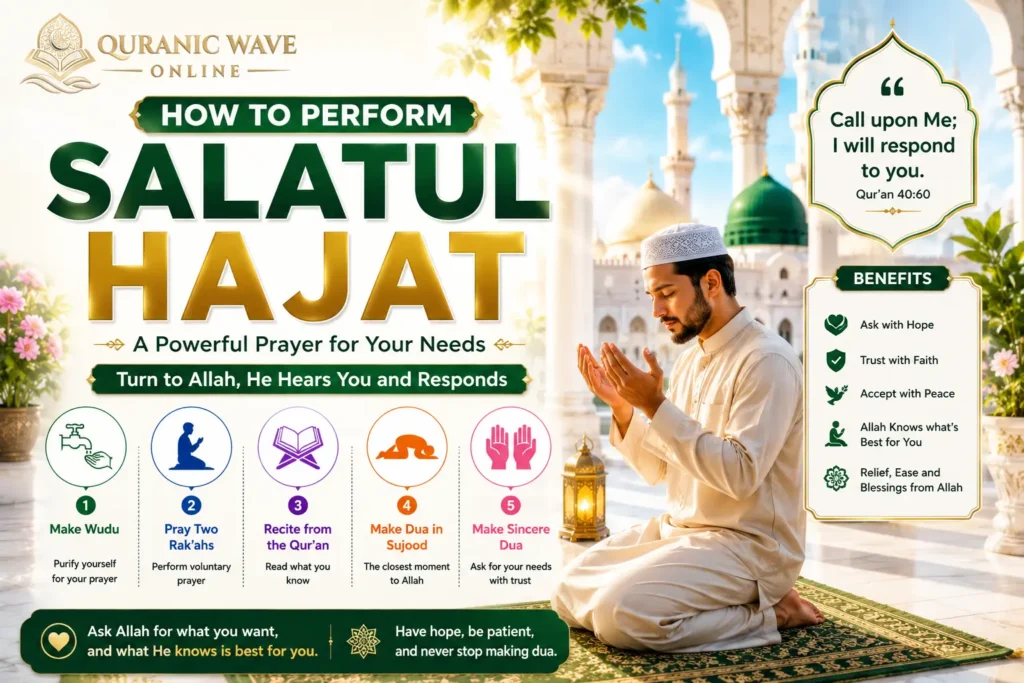
Learning how to perform Salatul Hajat is essential for any Muslim seeking Allah’s help during times of difficulty, anxiety, or deep personal need. There are moments in life when you simply do not know what to do—whether you are worried about family, health, marriage, or finances—and turning to prayer and sincere dua becomes your greatest comfort.
Allah tells the believers:
“And seek help through patience and prayer. Indeed, it is a burden except for the humble.”
— Qur’an 2:45
And He says:
“O believers! Seek comfort in patience and prayer. Allah is truly with those who are patient.”
— Qur’an 2:153
These verses establish an important principle: when life becomes difficult, a believer does not turn only to worldly solutions. We take the permissible means available to us and turn to Allah through prayer, patience and sincere dua.
What Is Salatul Hajat?
Salatul Hajat means the prayer performed when a person has a particular need or is seeking Allah’s help with an important matter. Salatul Hajat, commonly known as the Prayer of Need, is often practiced as two voluntary rak‘ahs followed by supplication.
The Arabic word hajah (حاجة) means a need, requirement or something a person desires.
People commonly use Salatul Hajat when they are asking Allah for help with matters such as:
- A difficult problem
- Financial difficulty
- Marriage
- Family matters
- Studies or examinations
- Employment
- A business matter
- Protection from hardship(you can also read our dedicated guide on dua for protection from enemies)
- Relief from anxiety or distress
- Guidance concerning an important decision
- Forgiveness and spiritual improvement
- A personal need that is halal and beneficial
The key is not the name of the prayer. The key is turning sincerely to Allah.
Allah says:
“And your Lord says, ‘Call upon Me; I will respond to you.’”
— Qur’an 40:60
Is Salatul Hajat Authentic?
This is one of the most important questions to answer honestly.
There is a well-known narration in Jami‘ at-Tirmidhi 479 describing a person with a need performing wudu, praying two rak‘ahs, praising Allah, sending blessings upon the Prophet ﷺ and then making a particular dua.
How to Perform Salatul Hajat Step by Step
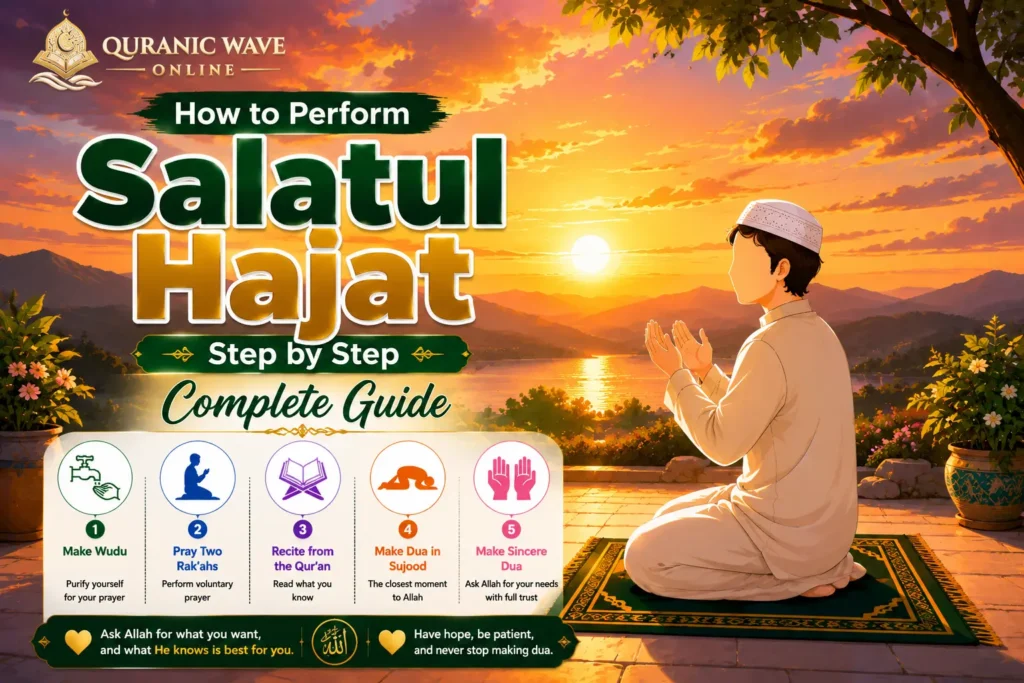
Step 1: Make Your Intention
Make the intention in your heart that you are praying voluntary salah and seeking Allah’s help with your need.
You do not have to say the intention aloud.
Your intention could simply be:
“I am praying two rak‘ahs of voluntary prayer seeking Allah’s help with my need.”
The need itself should be halal.
Step 2: Make Wudu
Perform wudu properly.
Then choose a clean place where you can pray without unnecessary distractions.
You can pray Salatul Hajat at home, in a masjid, or wherever voluntary prayer is permissible.
Step 3: Pray Two Rak‘ahs of Voluntary Salah
Pray two rak‘ahs as you would normally pray a voluntary prayer.
There is no sound evidence requiring a particular surah to be recited specifically for Salatul Hajat.
You may recite whatever portion of the Qur’an you know.
Step 4: Make Dua With Your Whole Heart
After finishing your salah, make sincere dua to Allah.
You can praise Allah, send blessings upon the Prophet ﷺ, and practice istighfar before making dua to explain your need and prepare your heart.
Speak to Allah honestly.
You can ask Him for:
- What you need
- What you fear
- What you cannot solve
- What you hope for
- Forgiveness for your mistakes
- Guidance
- Protection
- Barakah
- A better outcome than the one you imagined
Allah knows everything already, but dua is an act of worship and submission.
Make Plenty of Dua in Sujood
One of the most beautiful authentic teachings connected with seeking Allah’s help is the importance of dua during prostration.
The Prophet ﷺ said:
“The nearest a servant comes to his Lord is when he is prostrating himself, so make supplication in this state.”
Sahih Muslim 482
Think about the meaning.
The moment when your forehead is on the ground—when you are physically in the position of greatest humility—is also a special moment for dua.
So do not rush your sujood.
Ask Allah from your heart.
A Personal Routine: Praying When I Am in Trouble
There is also something deeply personal that can make this practice meaningful.
My own routine is that whenever I am in serious trouble or desperately want something, I turn to Allah through voluntary prayer and dua. If the matter is still weighing heavily on my heart, I may pray again later and continue asking Allah for that same specific need.
Sometimes I have prayed several times in one day for the same matter.
The purpose is not to believe that a certain number of prayers guarantees a result.
Rather, it is my way of repeatedly returning to Allah instead of allowing worry to consume me.
I make dua specifically for the matter troubling me, especially while in sujood, and I ask Allah to open the way if it is good for me.
And there is another part of this routine that is especially important:
I ask Allah not only to give me what I want, but to give me what He knows is better for me.
Salatul Hajat and Istikhara: What Is the Difference?
These two practices are sometimes confused.
| Salatul Hajat | Salat al-Istikhara |
|---|---|
| Connected with asking Allah for help with a need | Connected especially with seeking Allah’s guidance about a decision |
| You ask Allah for what you need | You ask Allah to choose what is best |
| You can offer general voluntary prayer alongside sincere supplication. | You recite the specific Istikhara supplication taught by the Prophet ﷺ |
|
Focuses on asking Allah to fulfill a specific, permissible need. |
Focuses on asking Allah to guide you to the best decision. |
The Prophet ﷺ taught the Companions Istikhara for matters they intended to undertake. Jabir رضي الله عنه reported that the Prophet ﷺ taught them Istikhara as he taught them chapters of the Qur’an, including praying two rak‘ahs other than the obligatory prayer and then making the well-known Istikhara supplication. Sahih al-Bukhari 6382.
So if your question is:
“Allah, please give me this thing.”
You may make dua and seek Allah’s help.
But if your question is:
“Allah, I don’t know whether this thing is actually good for me. Should I pursue it?”
Then Salat al-Istikhara is particularly relevant.
What Should You Say in Your Dua?
There is no requirement that your personal dua must be in Arabic.
You may ask Allah in whatever language you understand, particularly when making personal supplication outside the formal recitations of salah.
You can say:
“Ya Allah, I need Your help. You know my situation better than I know it myself. If what I am asking for is good for me, make it easy, bring it close and place barakah in it. If it is harmful for me, take it away from me, protect my heart from it and give me something better. Give me the strength to accept Your decision.”
This attitude combines dua with tawakkul.
You are asking Allah sincerely while recognizing that His knowledge is greater than yours.
Powerful Quranic Duas to Include
Along with your personal dua, you can use authentic supplications from the Qur’an.
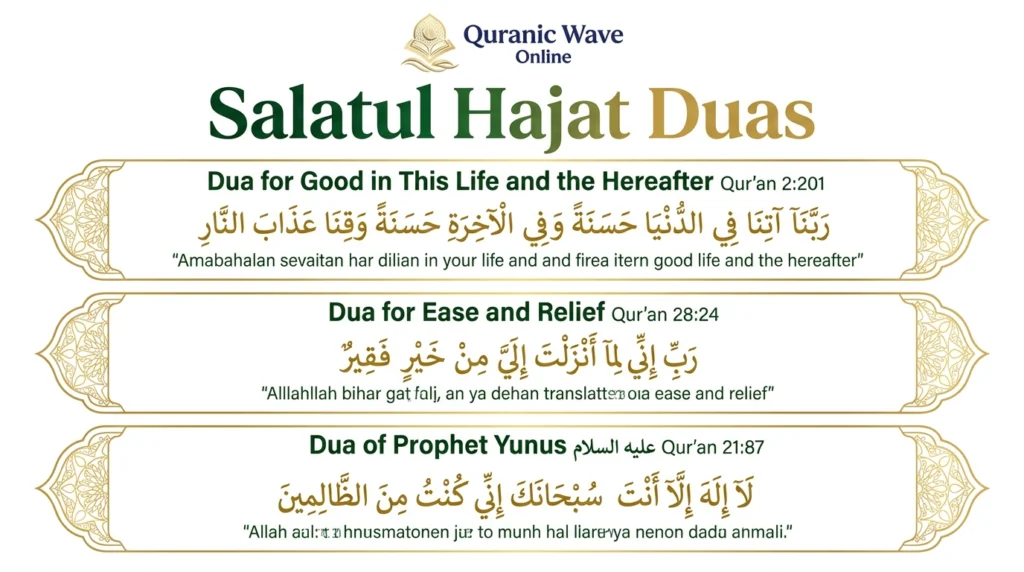
1. Dua for Good in This Life and the Hereafter
رَبَّنَا آتِنَا فِي الدُّنْيَا حَسَنَةً وَفِي الْآخِرَةِ حَسَنَةً وَقِنَا عَذَابَ النَّارِ
“Our Lord! Give us that which is good in this world and that which is good in the Hereafter, and protect us from the punishment of the Fire.”
Qur’an 2:201
This is one of the most comprehensive duas because it asks Allah for goodness without limiting His generosity to one specific outcome.
2. Dua for Ease and Relief
رَبِّ إِنِّي لِمَا أَنْزَلْتَ إِلَيَّ مِنْ خَيْرٍ فَقِيرٌ
“My Lord, I am truly in need of whatever good You send me.”
Qur’an 28:24
It is a beautiful dua when you recognize your complete dependence upon Allah.
3. Dua of Prophet Yunus عليه السلام
لَا إِلَٰهَ إِلَّا أَنْتَ سُبْحَانَكَ إِنِّي كُنْتُ مِنَ الظَّالِمِينَ
“There is no deity worthy of worship except You. Glory be to You! Indeed, I have been among the wrongdoers.”
Qur’an 21:87
It is a powerful expression of tawhid, glorification and repentance.
If you are turning to Allah during a difficult test, you may also find comfort in reading our guides on Powerful Duas for Forgiveness and Duas for Sickness to Go Away.
Authentic Hadiths About Salatul Hajat and Dua
“Whoever makes wudu and does it properly, then prays two rak’ahs completely, Allah will grant him whatever he asks for, sooner or later.”— Musnad Ahmad
A blind companion came to the Prophet ﷺ asking for a cure. The Prophet ﷺ instructed him:“Go, make wudu properly, pray two rak’ahs, and then make this dua…”— Sunan an-Nasa’i (10419) / Jami’ at-Tirmidhi (3578) (Graded Sahih)
“Whenever a matter distressed or burdened the Prophet ﷺ, he would immediately turn to prayer (Salah).”— Sunan Abi Dawud (1319) (Graded Hasan)
“Let one of you ask his Lord for all of his needs, even if it is for a shoestring when it breaks.”— Jami’ at-Tirmidhi (3604) (Graded Authentic)
Do Not Become Impatient
Sometimes we make dua once or twice and then become discouraged.
The Prophet ﷺ warned against this attitude.
He ﷺ said that a person’s supplication continues to be answered as long as they do not become impatient and say that they supplicated but were not answered.
Sahih Muslim 2735a.
Struggling with unanswered prayers?Discover why is my dua not being answered and how Allah is actually responding to you.
Does Allah Always Give Exactly What We Ask For?
Not necessarily.
And this is one of the most important lessons about dua.
You may ask Allah for a particular job, person, marriage, amount of money, opportunity or outcome.
But you do not know what is hidden behind it.
Something you desperately want today may become a source of hardship tomorrow.
Something you dislike today may eventually become the reason for tremendous good.
Can I Pray Salatul Hajat More Than Once?
Yes, you can, but you should avoid turning voluntary prayer into a rigid or fabricated ritual.
-
No Fixed Limit: There is no authentic maximum number of times you can pray voluntary salah or ask for the same need.
-
Avoid Unsubstantiated Formulas: Do not set fixed rules like praying it exactly 7 times or for 40 days to guarantee a result, as these require clear religious proof.
-
Focus on Persistence: Repeating your prayer should be driven by sincere persistence (dua) and relying on Allah, not by believing in a mandatory formula.
When Is the Best Time to Offer Salatul Hajat?
You can call upon Allah at any time.
A Powerful Personal Routine: Combining Four Blessed Times and Acts
-
The Last Third of the Night (Tahajjud): I pray when Allah descends to the lowest heaven and asks who is calling upon Him.
-
The Eve of Friday: I take advantage of the continuous mercy sent down starting at sunset on Thursday.
-
The Position of Sujood: I make my main supplications in prostration, when a servant is closest to Allah.
-
Salatul Hajat: I turn to voluntary prayer specifically to seek Allah’s help and relief.
While in prostration during this special time, I speak to Allah with complete faith, certainty, and humility:
“O Allah, I truly believe in You and in Your Messenger Muhammad ﷺ. Your Prophet ﷺ taught us that You descend to the lowest heaven in the last third of every night, that Friday is a blessed day of response, that supplications are accepted in sujood, and that turning to prayer in times of need brings Your help. O Allah, believing in all of these promises, I ask You to forgive my sins and grant me [mention your specific need].”
Combining firm belief (Eeman) in the Prophet’s ﷺ words with sincere worship creates a powerful connection between a servant and the Creator during the moments He loves most.
During Difficulty
Do not wait until your problem becomes unbearable.
Build the habit of turning to Allah in both ease and hardship.
Things to Avoid When Making Salatul Hajat
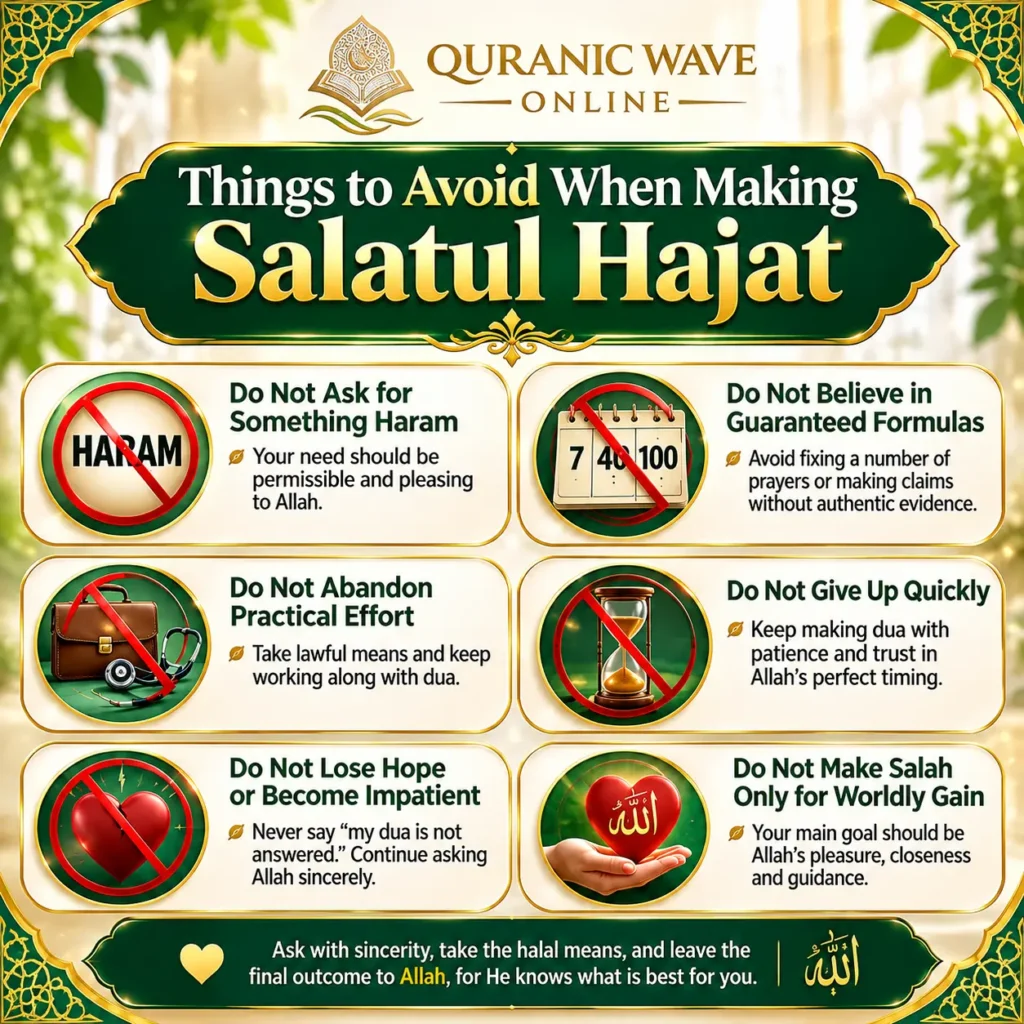
1. Do Not Ask for Something Haram
Your need should be permissible.
2. Do Not Believe in Guaranteed Formulas Without Evidence
Islam does not require us to believe that a specific number of rak‘ahs guarantees a specific worldly result.
3. Do Not Abandon Practical Effort
If you need a job, apply for jobs.
If you need medical treatment, seek qualified medical care.
If you have a family dispute, pursue lawful reconciliation.
Dua and taking permissible means belong together.
4. Do Not Give Up Quickly
The Prophet ﷺ taught believers not to become impatient with dua.
5. Do Not Make Your Entire Relationship With Allah About Getting Things
Allah deserves worship whether your particular request is granted immediately, later, differently, or not in the form you expected.
Salah is not merely a means of getting what we want.
It is an act of worship and a relationship with our Creator.
A Simple Salatul Hajat Routine You Can Follow
When something is seriously troubling you, try this simple routine:
- Make wudu.
- Calm yourself and turn your heart toward Allah.
- Pray two rak‘ahs of voluntary salah.
- Take your time in sujood.
- Make sincere dua for your specific need.
- Ask Allah to give you what is genuinely good for you.
- Ask Allah to remove anything harmful, even if it is something you desire.
- Continue taking permissible practical steps.
- Repeat your dua without impatience.
- Leave the final outcome to Allah.
The goal is not merely to say:
“Allah, give me what I want.”
The deeper goal is:
“Allah, I trust You with what I want, what I need, and what I cannot see.”
A Beautiful Dua for a Difficult Situation
You can make a personal dua like this:
Ya Allah, You know my situation, my worries and my needs better than I do. I turn to You because there is no strength and no power except through You. If this matter is good for my faith, my life and my future, make it easy for me, open the doors for me and place blessing in it. If it is not good for me, protect me from it, turn it away from me and give me something better. Most importantly, make my heart satisfied with whatever You choose for me. Give me patience while I wait, wisdom while I act, and complete trust in You. Ameen.
This type of dua reflects a beautiful balance:
Ask strongly. Trust completely. Accept Allah’s wisdom.
Salatul Hajat vs. Ordinary Dua
You do not have to wait for a special prayer before asking Allah for something.
You can make dua:
- While walking
- Before sleeping
- After salah
- During sujood
- In the last part of the night
- During difficult moments
- When something good happens
- When you simply feel the need to speak to Allah
Frequently Asked Questions About Salatul Hajat
What is Salatul Hajat?
Salatul Hajat is commonly understood as voluntary prayer performed when a person has a particular need and wants to seek Allah’s help.
How many rak‘ahs are prayed for Salatul Hajat?
The commonly described practice is two rak‘ahs, based on the narration recorded in Jami‘ at-Tirmidhi 479.
What should I recite in Salatul Hajat?
There is no reliably established authentic evidence requiring a particular surah for this prayer. You can recite Al-Fatihah followed by whatever portion of the Qur’an you know.
Can I make dua in sujood?
Yes. The Prophet ﷺ specifically encouraged making abundant supplication while prostrating. Sahih Muslim 482.
Can I pray Salatul Hajat more than once?
There is no authentic evidence establishing a specific maximum number of times for this purpose. You may continue making dua and perform voluntary prayer until you find an answer or a way to calm down.
Can I ask Allah for a specific person or thing?
Yes, if what you are asking for is halal. It is also wise to ask Allah to give you that thing if it is good for you and to give you something better if it is not.
Can I make dua in my own language?
Personal dua may be made in a language you understand, particularly outside the formal Arabic recitations of salah. Speaking to Allah sincerely and understanding what you are asking for can help you make heartfelt supplication.
What if Allah does not give me what I asked for?
Do not assume that your dua was ignored. The Qur’an teaches that Allah responds to the supplicant, while the Sunnah warns against becoming impatient.
Sometimes the answer comes differently from what we expected.
Final Thoughts: Take Your Problem to Allah
When you are frightened, confused or exhausted, remember that you do not have to carry everything alone.
Allah Himself tells us to seek help through patience and prayer.
So pray.
Ask.
Cry if you need to.
Tell Allah exactly what is in your heart.
Ask Him for what you want—but also ask Him for what is best.
And when you rise from your prayer, continue doing what you can while trusting the One who controls the outcome.
Perhaps the thing you are desperately asking Allah to give you is already on its way.
Perhaps Allah is preparing something better.
Perhaps He is protecting you from something you cannot see.
And perhaps the greatest answer to your dua will be a heart that becomes closer to Him.
If you are facing a difficult situation today, make wudu, pray two rak‘ahs of voluntary prayer, spend time in sincere dua, and place your matter in Allah’s hands.
Ask Him for what you desire. Ask Him for what is best. And ask Him to make your heart content with His decree.
May Allah ease every hardship, answer every sincere halal dua, remove every difficulty, grant what is beneficial, protect us from what is harmful, and make us among those who turn to Him in every situation. Ameen.
Key Takeaways
- Salatul Hajat is commonly practiced as voluntary prayer for a person’s need.
- The Qur’an clearly teaches believers to seek help through patience and prayer.
- Allah promises: “Call upon Me; I will respond to you.”
- The Prophet ﷺ encouraged abundant dua during sujood.
- Continue making dua without becoming impatient.
- Take permissible practical means alongside dua.
- Ask Allah for what you want while also asking Him to choose what is best.
- Never attach guaranteed results to a specific number of prayers or a formula without authentic evidence.
- Above all, let your need bring you closer to Allah, not merely closer to the thing you want.
Pingback: Authentic Duas for Job and Marriage - Quranic Wave
Pingback: Duas for Hardship, Anxiety, and Distress - Quranic Wave