

Darood Sharif, or Salawat upon the Prophet Muhammad ﷺ, is a beautiful act of worship through which we express our love, respect, and gratitude toward the Messenger of Allah ﷺ. While it is a simple act of remembrance, the Qur’an and authentic Sunnah give it an elevated status.
In my own daily life, reciting Salawat brings an overwhelming sense of peace, and I always encourage fellow Muslims to build this habit based on authentic teachings.
Allah Himself commands believers to send blessings and peace upon the Prophet ﷺ:
“Indeed, Allah confers blessing upon the Prophet, and His angels [ask Him to do so]. O you who have believed, ask [Allah to confer] blessing upon him and ask [Allah to grant him] peace.”
— Qur’an 33:56
This verse contains three profound points:
-
Allah’s Divine Action: Allah Himself confers blessings upon Prophet Muhammad ﷺ.
-
The Honor of the Angels: The angels constantly send blessings upon the Prophet ﷺ.
-
A Direct Command for Believers: Believers are explicitly instructed to invoke blessings and peace upon him.
Sending blessings upon the Prophet ﷺ isn’t just a custom or habit—it is a divine command. In this guide, I will walk you through the authentic Darood Sharif with English transliteration and translation, its Qur’anic foundation, virtues from authentic hadith, the best times to recite it, and the exact forms taught in the Sunnah.
What Is Darood Sharif?
Darood Sharif (also known as Salawat) refers to invoking blessings and peace upon Prophet Muhammad ﷺ.
Beyond general blessings, reciting Darood carries special rewards highlighted in authentic Sunnah:
“The person who will be closest to me on the Day of Resurrection is the one who sent the most blessings upon me.” — Jami` at-Tirmidhi
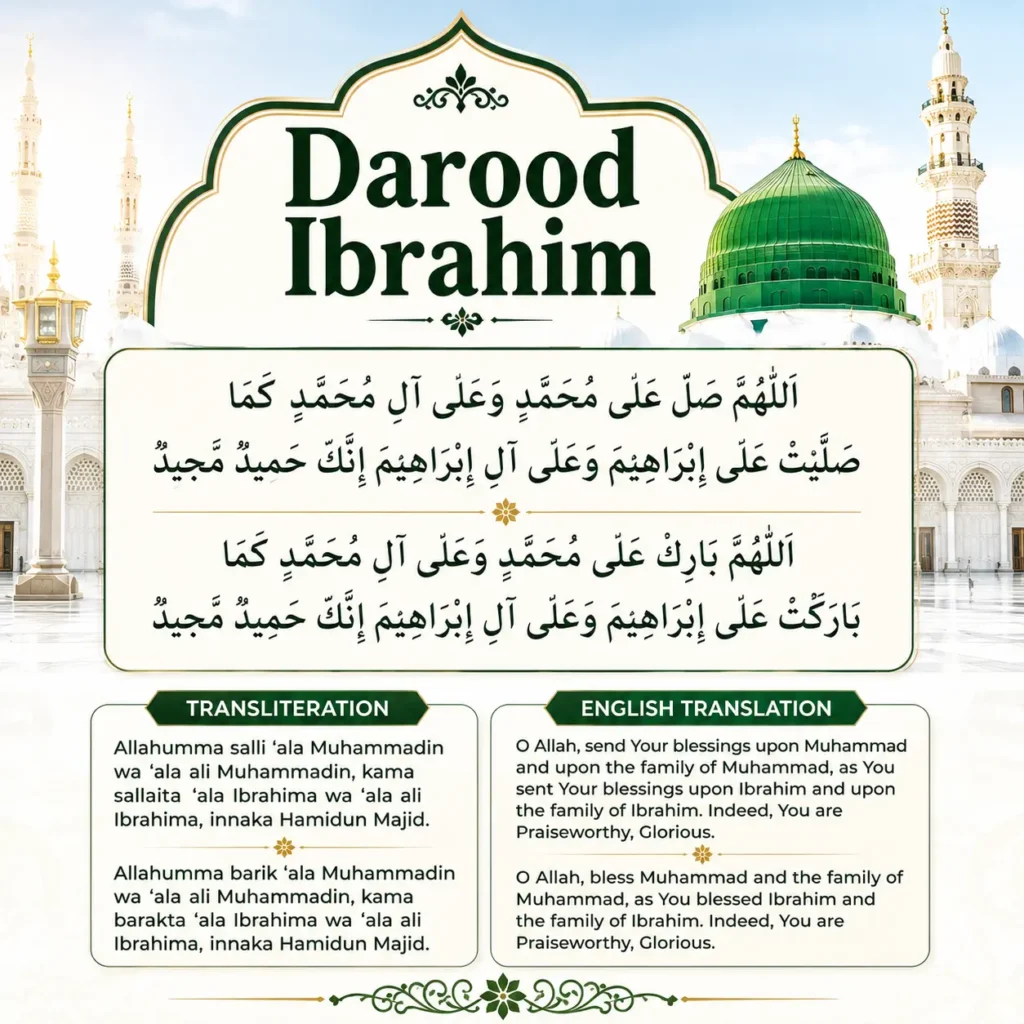
The Most Authentic Darood Sharif: Darood Ibrahim
Among the best-known authentic forms of Darood is Salat Ibrahimiyyah, commonly called Darood Ibrahim.
When I first learned how to recite this correctly, I realized how essential it is to understand both its meaning and pronunciation. It was taught directly by the Prophet ﷺ when his Companions asked him how they should send blessings upon him (Sahih al-Bukhari 3370, Sahih Muslim 406).
Arabic
اللَّهُمَّ صَلِّ عَلَىٰ مُحَمَّدٍ وَعَلَىٰ آلِ مُحَمَّدٍ كَمَا صَلَّيْتَ عَلَىٰ إِبْرَاهِيمَ وَعَلَىٰ آلِ إِبْرَاهِيمَ إِنَّكَ حَمِيدٌ مَجِيدٌ
اللَّهُمَّ بَارِكْ عَلَىٰ مُحَمَّدٍ وَعَلَىٰ آلِ مُحَمَّدٍ كَمَا بَارَكْتَ عَلَىٰ إِبْرَاهِيمَ وَعَلَىٰ آلِ إِبْرَاهِيمَ إِنَّكَ حَمِيدٌ مَجِيدٌ
English Transliteration
Allahumma salli ‘ala Muhammadin wa ‘ala ali Muhammadin, kama sallaita ‘ala Ibrahima wa ‘ala ali Ibrahima, innaka Hamidun Majid.
Allahumma barik ‘ala Muhammadin wa ‘ala ali Muhammadin, kama barakta ‘ala Ibrahima wa ‘ala ali Ibrahima, innaka Hamidun Majid.
English Translation
O Allah, send Your blessings upon Muhammad and upon the family of Muhammad, as You sent Your blessings upon Ibrahim and upon the family of Ibrahim. Indeed, You are Praiseworthy, Glorious.
O Allah, bless Muhammad and the family of Muhammad, as You blessed Ibrahim and the family of Ibrahim. Indeed, You are Praiseworthy, Glorious.
Another Authentic Form of Darood Ibrahim
There is more than one authentic wording of Salat Ibrahimiyyah.
In Sahih Muslim 407, Abu Humaid As-Sa’idi رضي الله عنه reported that the Companions asked the Messenger of Allah ﷺ how they should bless him. He taught them:
Transliteration
Allahumma salli ‘ala Muhammadin wa ‘ala azwajihi wa dhurriyyatihi kama sallaita ‘ala ali Ibrahim, wa barik ‘ala Muhammadin wa ‘ala azwajihi wa dhurriyyatihi kama barakta ‘ala ali Ibrahim, innaka Hamidun Majid.
Meaning
O Allah, bless Muhammad, his wives and his offspring as You blessed the family of Ibrahim, and grant blessings to Muhammad, his wives and his offspring as You granted blessings to the family of Ibrahim. Indeed, You are Praiseworthy, Glorious.
This is important because authentic Sunnah contains different wordings of Salat upon the Prophet ﷺ. Muslims do not need to restrict themselves to one wording when authentic alternatives have been transmitted.
Short Forms of Darood Sharif
-
Sallallahu Alayhi Wa Sallam
-
Arabic: صَلَّى ٱللَّٰهُ عَلَيْهِ وَسَلَّمَ
-
Transliteration: Sallallahu ‘alayhi wa sallam
-
Meaning: “May Allah send blessings and peace upon him.”
-
-
Allahumma Salli ‘Ala Muhammad
-
Arabic: اللَّهُمَّ صَلِّ عَلَىٰ مُحَمَّدٍ
-
Transliteration: Allahumma salli ‘ala Muhammad
-
Meaning: “O Allah, send blessings upon Muhammad.”
-
-
Sallallahu ‘Ala Muhammad
-
Arabic: صَلَّى ٱللَّٰهُ عَلَىٰ مُحَمَّدٍ
-
Transliteration: Sallallahu ‘ala Muhammad
-
Meaning: “May Allah send blessings upon Muhammad.”
-
-
Allahumma Salli Wa Sallim ‘Ala Muhammad
-
Arabic: اللَّهُمَّ صَلِّ وَسَلِّمْ عَلَىٰ مُحَمَّدٍ
-
Transliteration: Allahumma salli wa sallim ‘ala Muhammad
-
Meaning: “O Allah, send blessings and peace upon Muhammad.”
-
Therefore, Salawat is firmly established in the Qur’an, while the Sunnah explains the wording and practice.
Authentic Hadiths About the Virtues of Darood Sharif
1. One Salawat Brings Ten Blessings From Allah
One of the clearest virtues comes from Sahih Muslim.
The Prophet ﷺ said:
“He who blesses me once, Allah would bless him ten times.”
This means that when a believer sends one Salat upon the Prophet ﷺ, Allah grants that person ten blessings.
It is an enormous reward for a deed that can take only a few seconds.
2. Darood Is Especially Encouraged on Friday
Friday has a special connection with Salawat.
The Prophet ﷺ said:
“Among the most excellent of your days is Friday … so invoke more blessings on me that day, for your blessings will be submitted to me.”
This narration is recorded in Sunan Abi Dawud 1047.
So Friday is an excellent opportunity to increase your Darood.
You could make a simple habit of reciting Salawat:
- After Fajr
- During your morning routine
- While traveling
- Before Jumu’ah
- After Jumu’ah
- In the evening
- Before going to sleep
There is no need to turn this into a complicated ritual. Consistency is more important than making an unnecessarily difficult routine.
3. Salawat Is Part of the Sunnah After the Tashahhud
The well-known Salat Ibrahimiyyah is part of the established Sunnah recited inside prayer right after the Tashahhud.
4. Closeness to the Prophet ﷺ on the Day of Judgment
Abdullah ibn Mas’ud رضي الله عنه reported that the Messenger of Allah ﷺ said:
“The people who will be nearest to me on the Day of Resurrection are those who send the most blessings upon me.” (Jami` at-Tirmidhi)
What Are the Benefits of Reading Darood Sharif?
The authentic texts establish several virtues:
- Obeying Allah’s command in Qur’an 33:56.
- Receiving Allah’s blessings when sending one Salat upon the Prophet ﷺ.
- Receiving ten blessings from Allah for one Salat, according to Sahih Muslim.
- Following the teaching of the Prophet ﷺ by using the forms of Salawat he taught.
- Increasing Salawat on Friday, following the Prophetic instruction.
- Expressing love, respect, and reverence for the Messenger of Allah ﷺ.
- Including Salawat in the prayer, as taught in authentic hadith.
A necessary reminder
It is common to find claims online that reciting a specific Darood a set number of times will cure diseases, guarantee wealth, or fulfill worldly wishes.
We must distinguish between:
-
What the Qur’an and authentic Sunnah establish: Virtues explicitly promised in authentic texts.
-
Popular claims: Special numerical formulas or guarantees lacking reliable evidence.
Darood is deeply virtuous, but we should not attach unsupported promises to it without authentic proof.
When Should You Read Darood Sharif?
There is no need to wait for one particular time but try to make a daily habit of your life.
Morning:
After Fajr, spend a few moments sending Salawat upon the Prophet ﷺ.
Salawat can be part of your daily remembrance, while certain occasions have specific evidence for increased emphasis.
1. During Salah:
The Salat Ibrahimiyyah is recited in the prayer after Tashahhud, before the final Salam, according to the established Prophetic practice.
2. On Friday:
Increase your Salawat on Friday because the Prophet ﷺ specifically encouraged doing so.Friday holds immense blessings in Islam—read our detailed article on Surah Kahf to maximize your rewards.
3. When the Prophet ﷺ Is Mentioned:
Failing to send blessings upon hearing his name is warned against.
“The miser is the one in whose presence I am mentioned who does not send blessings upon me.” — Jami` at-Tirmidhi (Graded Sahih)
4. After Hearing the Adhan:
Asking Allah to grant him Al-Wasilah.
“When you hear the Mu’adhdhin, repeat what he says, then send blessings upon me… then ask Allah to grant me Al-Wasilah, for whoever asks Al-Wasilah for me, my intercession becomes guaranteed for him.” — Sahih Muslim
5. During Personal Dhikr:
Incorporating Salawat into your daily personal remembrance brings immense relief from worries and forgives sins. When a companion offered to devote all his supplication time to sending blessings, the Prophet ﷺ promised him complete peace of mind.
“Then your worries will be taken care of and your sins will be forgiven.” — Jami` at-Tirmidhi (Graded Hasan-Sahih)
6. Before Sleeping
End your day with remembrance of Allah and Salawat upon His Messenger ﷺ.
The objective is not to create pressure around a particular number. The objective is to develop a sincere and consistent habit.
How to Read Darood Sharif Correctly
You do not need special equipment, a particular location, wudu, or a special posture.
A simple approach is:
- Make the intention to worship Allah and follow the Sunnah.
- Choose an authentic wording of Salawat.
- Pronounce the Arabic carefully if you are able.
- Understand the meaning rather than repeating the words mechanically.
- Recite regularly as part of your daily dhikr.
- Increase your Salawat on Friday.
- Use Salat Ibrahimiyyah in Salah as taught in the Sunnah.
If you cannot pronounce Arabic perfectly
Do not let difficulty stop you from learning.
Start slowly. Listen to reliable recitation, learn the pronunciation phrase by phrase, and gradually improve.
English transliteration can help beginners, but it should be treated as a learning aid, not a permanent replacement for learning the Arabic pronunciation.
Darood Sharif With English Transliteration: Quick Reference
| Form | Transliteration | Main Use |
|---|---|---|
| Salat Ibrahimiyyah | Allahumma salli ‘ala Muhammadin… | Salah and general Salawat |
| Short Salawat | Allahumma salli wa sallim ‘ala Muhammad | Simple daily remembrance |
| Salat upon hearing Adhan | Send blessings after repeating the Adhan | After Adhan |
| Increased Salawat | Any authentic wording | Especially Friday |
The safest approach is to prioritize wordings directly taught by the Prophet ﷺ rather than assuming every popular formula called “Darood” has the same level of authenticity.
Are All Famous Darood Formulas Authentic?
No.
While popular formulas like Darood Tanjeena, Darood Taj, or Darood Nariya contain praise, they were composed by later scholars and lack direct Prophetic narration. In contrast, Salat Ibrahimiyyah was explicitly taught word-for-word by Prophet Muhammad ﷺ.
The Companions said, “O Messenger of Allah, we know how to greet you, but how should we send blessings upon you?” He replied: “Say: O Allah, send Your blessings upon Muhammad and upon the family of Muhammad, as You sent blessings upon Ibrahim…” — Sahih al-Bukhari 3370 / Sahih Muslim 406
The key distinction
Darood Ibrahim / Salat Ibrahimiyyah:
Its wording is directly established in authentic hadith.
Other later formulas:
Some may contain permissible supplications and praise, but their specific wording or claimed special virtues may not be established from the Prophet ﷺ.
Therefore, if your goal is to follow the authentic Sunnah, prioritize the forms whose wording is established in Sahih hadith.
This distinction protects Muslims from accidentally attributing something to the Prophet ﷺ without evidence.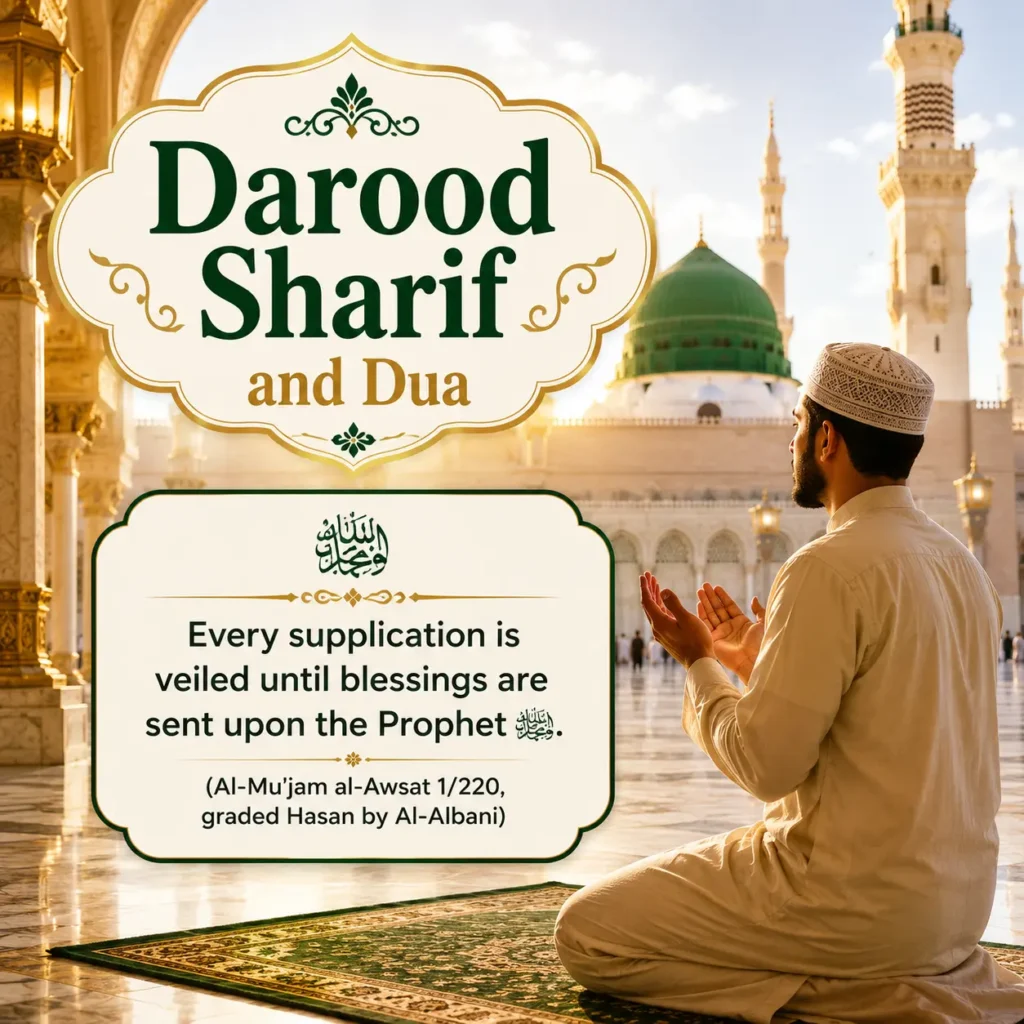
Darood Sharif and Dua: Is There a Connection?
Sending blessings upon the Prophet ﷺ opens the doors for our supplications to be answered by Allah. Ali ibn Abi Talib رضي الله عنه reported that the Messenger of Allah ﷺ said:
“Every supplication is veiled until blessings are sent upon the Prophet ﷺ.” (Al-Mu’jam al-Awsat 1/220, graded Hasan by Al-Albani)
However, Muslims should avoid claiming that there is one universally guaranteed formula such as:
“Read Darood exactly X times and your specific dua will definitely be accepted.”
Unless a specific number, wording, or promised outcome is supported by reliable evidence, it should not be presented as a Prophetic guarantee.
The power of Darood does not require exaggerated claims. The authentic evidence is already sufficient.
Darood Sharif: Common Questions
Is Darood Sharif mentioned in the Quran?
The exact commonly recited authentic wording of Darood Ibrahim is not presented in the Qur’an.While the exact wording of Salat Ibrahimiyyah is taught in the Sunnah, sending blessings upon Prophet Muhammad ﷺ is explicitly commanded by Allah in Surah Al-Ahzab (33:56)
What is the most authentic Darood Sharif?
Salat Ibrahimiyyah (Darood Ibrahim) is among the most authentic and well-established forms because the Prophet ﷺ explicitly taught its wording to his Companions. It is recorded in Sahih al-Bukhari and Sahih Muslim.
How many times should I read Darood Sharif?
There is no need to claim a universal daily number unless a specific number is established by authentic evidence. You may send Salawat regularly throughout the day and increase it on Friday.
Can I read Darood Sharif in English?
You can learn its meaning in English, and transliteration can help with pronunciation. For the actual Arabic wording of an Arabic dhikr, however, learning and reciting the Arabic is preferable.
Can women read Darood Sharif?
Yes. Sending Salawat upon the Prophet ﷺ is an act of remembrance that both men and women may perform.
Can I read Darood Sharif without wudu?
Salawat is a form of dhikr and is not restricted to the same conditions as Salah. Therefore, one may send Salawat outside the prayer without wudu.
Should I only read Darood Ibrahim?
No. Authentic hadith contain more than one wording of Salat upon the Prophet ﷺ. Darood Ibrahim is especially well known and firmly established, but authentic alternative wordings also exist.
Is Darood Sharif obligatory every time the Prophet’s name is mentioned?
Scholars have differed over the ruling regarding repeating Salawat every time his name is mentioned. What is unquestionably encouraged is to honor the Prophet ﷺ and send Salawat upon him. The safest practice is not to neglect this beautiful Sunnah.
Important Difference Between Authentic Evidence and Popular Claims
Islam encourages us to love the Prophet ﷺ, but that love should be guided by authentic knowledge.
When reading about Darood Sharif online, ask:
- Is the wording actually reported from the Prophet ﷺ?
- Is the hadith authentic?
- Is the claimed number supported by evidence?
- Is the promised worldly benefit actually mentioned in the Qur’an or Sunnah?
- Is the statement being attributed to the Prophet ﷺ without a reliable source?
This simple habit helps protect Islamic content from exaggerated or unsupported claims.
Why Darood Should Become Part of Your Daily Life
Darood does not require a long appointment in your schedule.
You can send Salawat while:
- Walking
- Driving or traveling
- Waiting for an appointment
- Doing household work
- Sitting quietly
- After Salah
- Before sleeping
- On Friday
- After hearing the Adhan
A few sincere moments can turn an ordinary part of your day into remembrance.
And the authentic promise is remarkable: whoever sends one blessing upon the Prophet ﷺ receives ten blessings from Allah.
Final Thoughts
Darood Sharif is a simple yet deeply meaningful act of worship. By choosing authentic wordings like *Salat Ibrahimiyyah*, understanding their meaning, and building a regular daily practice—especially on Fridays—we fulfill a noble divine command while remaining grounded in the authentic Sunnah.
Start today: integrate one authentic Salawat into your daily routine and keep your practice strictly aligned with proven evidence.
May Allah send abundant blessings and peace upon our beloved Prophet Muhammad ﷺ, his family, and his Companions, and may He allow us to follow his Sunnah with sincerity. Ameen.