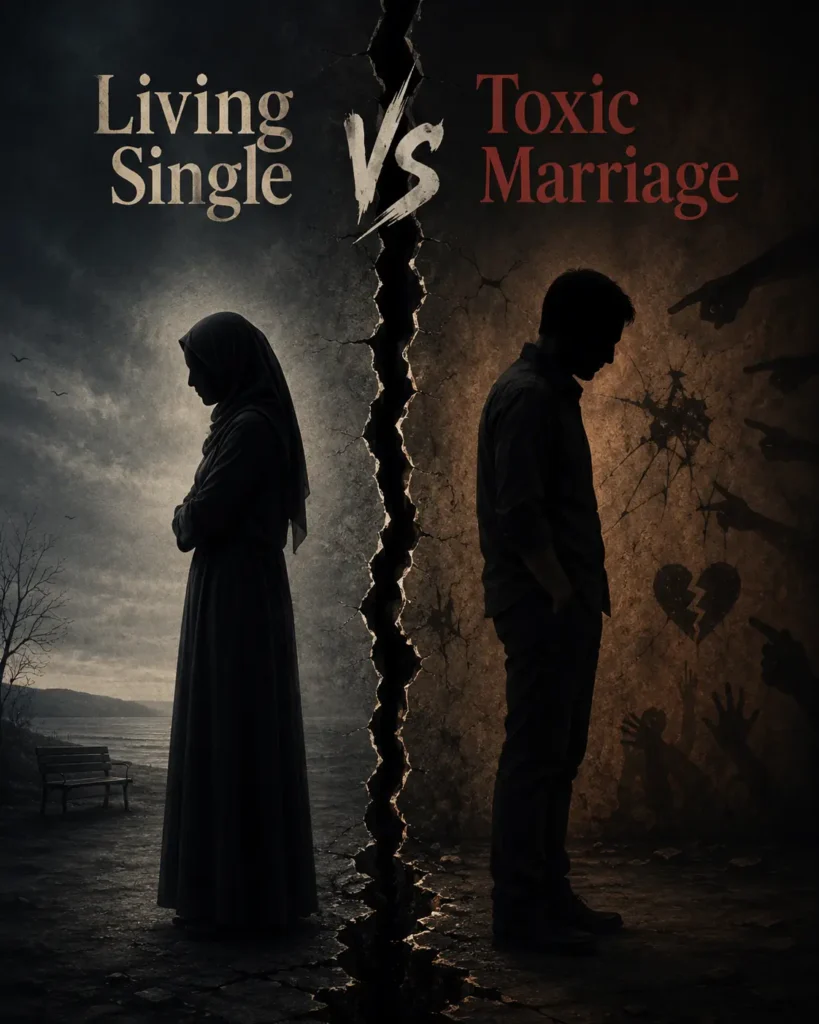
When exploring living single vs toxic marriage, I often remind readers that while Islam deeply values marriage as a source of peace and mercy, it never requires anyone to remain trapped in continuous emotional abuse, intimidation, or harm.
A true Islamic marriage is built on justice and respect—not a legal title alone. Attempting sincere, safe reconciliation is always valuable when realistic, but choosing a peaceful single life through lawful separation is far healthier than remaining in a relationship that destroys your faith, dignity, or mental well-being.
Evaluating your options comes down to asking a fundamental question: Is your relationship being lived according to the mercy that Allah requires, or is it causing continuous harm?
What Does Islam Say Marriage Is Supposed to Be?
“And of His signs is that He created for you from yourselves mates that you may find tranquillity in them; and He placed between you affection and mercy.”(Quran 30:21)
-
Normal disagreements vs. constant intimidation
-
Occasional frustration vs. deliberate humiliation
-
Imperfect communication vs. years of continuous emotional abuse
“The best of you are those who are the best to their wives.”(Riyad as-Salihin 278; al-Tirmidhi)
Why Islam Prioritizes Your Mental Peace Over a Damaging Relationship
Islam does not use modern psychological terminology in the Quran, but its principles clearly reject oppression, cruelty, injustice, and deliberate harm.
Allah says:
“And live with them in kindness.”
Quran 4:19
This Quranic instruction is fundamental. A spouse cannot claim to fulfill their Islamic duties while actively destroying their partner’s dignity through threats, humiliation, or cruelty.
In my work guiding individuals, I frequently see how hidden psychological harm can be:
- Invisible wounds: A person may appear completely healthy while privately living in constant anxiety.
- Emotional exhaustion: Waking up every day fearing the next argument or walking on eggshells.
- Loss of self-worth: Gradually losing confidence, isolating from loved ones, or feeling perpetually inadequate.
This profound suffering should never be dismissed or ignored.
Your life is an amanah from Allah. A marriage is important, but marriage does not give another person unlimited permission to destroy you.
Choosing Peace Over Pain: Islamic Guidance on Divorce and Khula
“Then retain them according to acceptable terms or separate from them with grace.”(Quran 2:229)
“The most hateful of permissible things to Allah is divorce.” (Sunan Ibn Majah 2018)
“Do not keep them, intending harm, to transgress against them.”(Quran 2:231)
What About Khula?
Islam also recognizes khula, through which a woman can seek release from a marriage.
A well-known authentic example is the wife of Thabit ibn Qays. She approached the Prophet ﷺ and explained that she did not accuse her husband of bad character or religious deficiency, but she did not want to continue the marriage. The Prophet ﷺ facilitated the separation after she agreed to return the garden that had been given as her mahr. Sahih al Bukhari 5276
This hadith is significant because it demonstrates that Islam does not require a woman to remain married against her will simply because the marriage technically exists.
The exact rules and procedures of khula, talaq, judicial divorce, and separation can vary according to circumstances and legal schools, so someone facing a real case should consult a trustworthy qualified scholar and, where necessary, the appropriate legal authority.
The Impact of Silent Suffering on Mental Health
One of the most damaging messages I hear suffering spouses receive is: “Just tolerate it. Everyone has marital problems.”
While every relationship faces challenges, ordinary conflict is not systematic abuse. Islamic patience (sabr) means maintaining faith during trials—it does not require submitting to ongoing oppression.
When evaluating a toxic relationship, I urge you to look out for these critical warning signs:
-
Emotional abuse: Persistent insults, public humiliation, or intense guilt-tripping.
-
Control & isolation: Financial restriction, isolation from loved ones, or psychological manipulation.
-
Safety threats: Intimidation, severe control, or threats of physical harm.
These behaviors should never be hidden just to save face. In my view, protecting a family in Islam truly means stopping the harm inside it.
Toxic Relationship vs. Solo Peace: When Islam Allows You to Move On
Living single is not automatically superior to marriage, but staying in a harmful relationship is not required.
When sincere efforts at reconciliation fail, Allah provides an honorable way out:
“And if they separate [by divorce], Allah will enrich each [of them] from His abundance.”
(Quran 4:130)
In my guidance to individuals, I often emphasize that if you have honestly tried to repair the relationship and nothing changes, Islam gives you a clear, dignified choice to separate.
Remaining trapped in continuous toxicity often leads both spouses to act out of anger, bitterness, or injustice—making them fall into sin. In such cases, choosing a peaceful single life allows you to preserve your character, maintain your faith, and live in tranquility rather than resorting to wrong behavior in return.
A simple way to look at it
| Situation | Islamic priority |
|---|---|
| Healthy marriage | Protect and nurture it |
| Ordinary disagreement | Communicate and resolve it |
| Serious recurring conflict | Seek wise mediation |
| Emotional or psychological abuse | Take the harm seriously |
| Physical violence | Prioritize safety and protection |
| Repeated abuse without genuine change | Consider legitimate separation options |
| Immediate danger | Get to safety and seek urgent help |
Saving Yourself First: Why Islam Prohibits Mental Abuse in Marriage
Islam explicitly forbids oppression (dhulm) and mistreatment, regardless of whether the offender is a stranger or your spouse.
In a powerful Hadith Qudsi, Allah commands:
“O My servants, I have forbidden oppression for Myself and have made it forbidden among you, so do not oppress one another.”
(Sahih Muslim 2577)
Furthermore, the Quran reinforces this fundamental right to fair treatment:
“And do not harm them in order to oppress them.”
(Quran 65:6)
In my work guiding couples, I often stress that the Prophet ﷺ exemplified patience and gentleness—Aisha (RA) reported that he never struck a woman or servant with his hand (Sahih Muslim 2328a). Cruelty, emotional manipulation, and mental torture cannot be excused as “marital discipline,” nor should a victim ever be blamed for being abused.
When a relationship turns into persistent psychological harm, protecting your mental well-being and dignity is a divine right, not a spiritual failing.
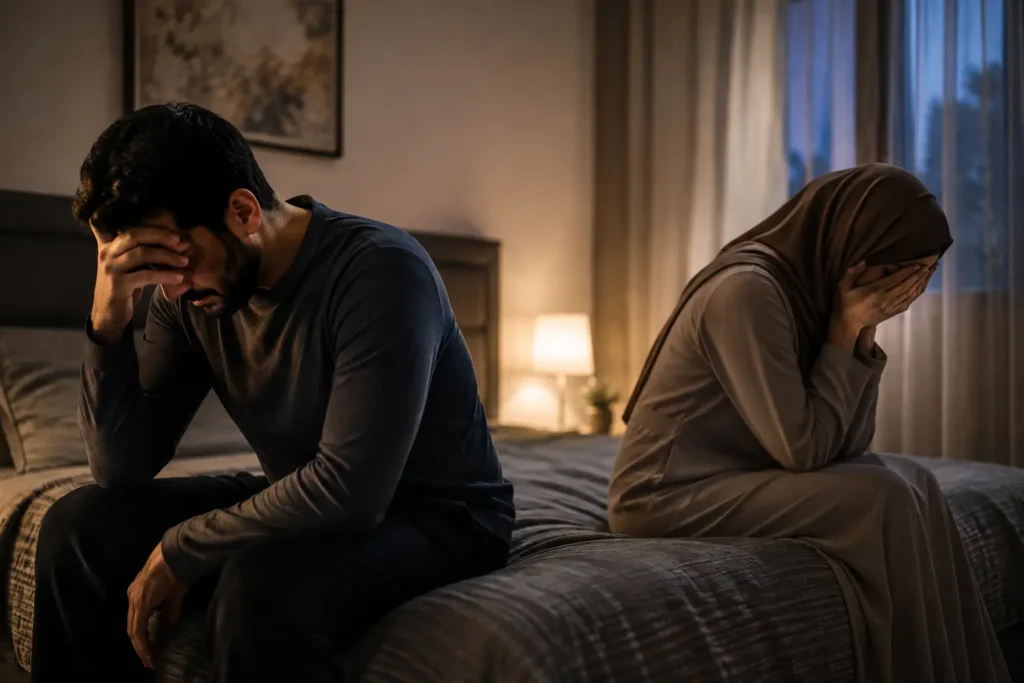
Should You Involve Parents, Relatives, Neighbours, or Everyone?
Islam encourages family mediation during marital disputes:
“And if you fear dissension between the two, send an arbitrator from his people and an arbitrator from her people.”
(Quran 4:35)
While involving wise mediators can help save a marriage when both partners genuinely want to reconcile, I always remind readers to recognize when mediation becomes harmful.
In my work guiding individuals, I frequently see cases where relatives continually intervene, promises are broken, and the same cycle of mistreatment repeats:
-
Endless Interventions: Relatives repeatedly attempt to “fix” a spouse who refuses to take personal accountability.
-
Exhaustion Over Safety: The suffering spouse becomes physically and mentally drained while being pressured to endure harm just to maintain appearances.
Reconciliation is valuable only when there is mutual effort and genuine reform. In my view, “saving the marriage” should never mean sacrificing a person’s safety, dignity, and mental well-being to protect social standing.
The Cost of Trying to Fix a Broken Spouse
You can advise someone.
You can encourage them.
You can involve wise family members.
You can suggest counseling or religious guidance.
You can pray for them.
But you cannot force another adult to become a good spouse.
A person who refuses responsibility may repeatedly make promises without meaningful change.
Look for consistent behavior, not simply emotional apologies.
Real improvement may involve:
- admitting the wrongdoing;
- stopping abusive behavior;
- accepting reasonable boundaries;
- seeking qualified help;
- taking responsibility without blaming the victim;
- maintaining change over time.
A single apology after months of abuse does not automatically prove transformation.
Managing Severe Emotional Stress and Seeking Support
When marital distress causes severe emotional breakdown or safety fears, the situation becomes an urgent health priority rather than a standard disagreement.
In my work, I always advise taking immediate, practical action:
-
Prioritize Safety: Step away from volatile confrontations and create physical distance immediately.
-
Seek Support: Involve trusted family members, friends, or local leaders who offer a safe environment.
-
Get Professional Help: Contact professional healthcare providers or crisis support services right away.
The Quran places supreme importance on preserving human life. Islam never demands that you remain in a dangerous environment to prove your patience—your safety and health always come first.
Living a Fulfilling Islamic Life Single
-
Spiritual Growth: Strengthening your personal connection with Allah through worship.
-
Inner Peace: Rebuilding mental tranquility and self-worth in a safe environment.
-
Purpose & Growth: Pursuing halal goals, education, community work, and strong family ties.
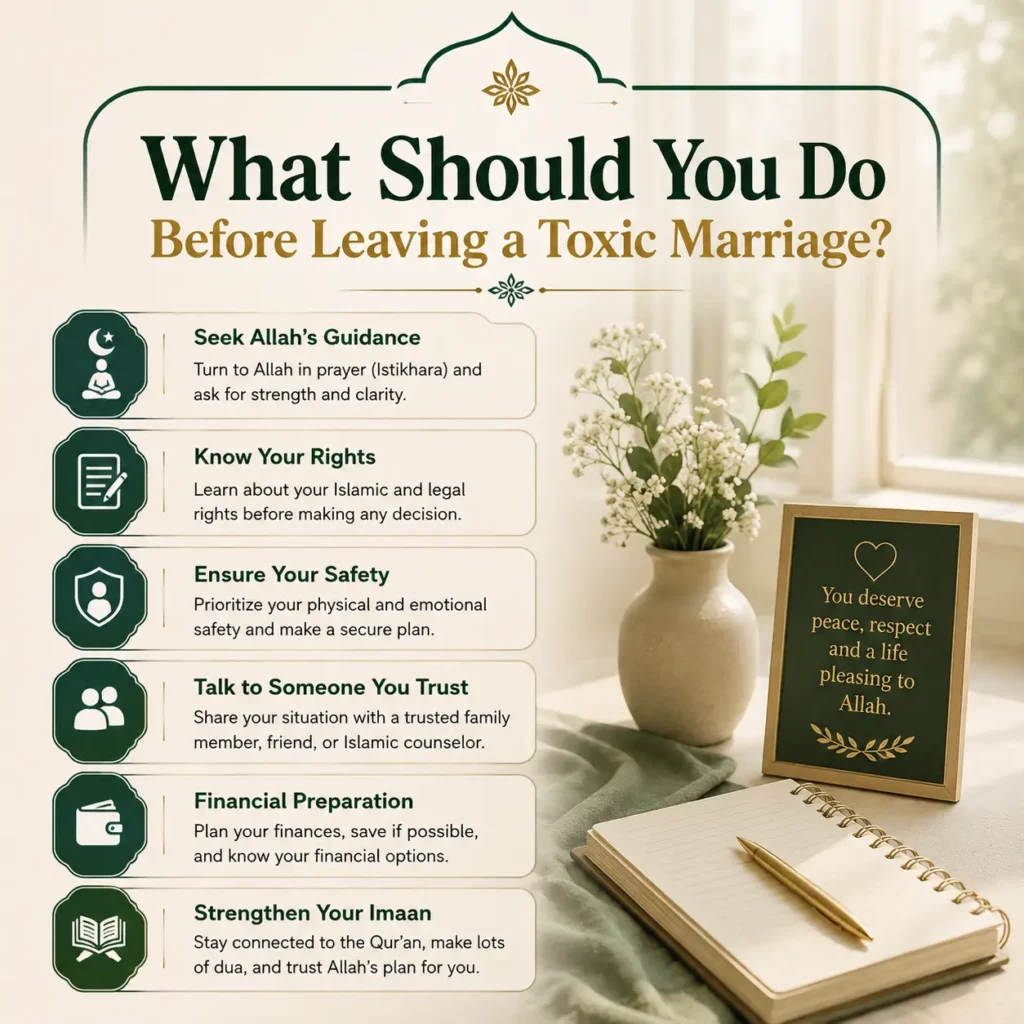
What Should You Do Before Leaving a Toxic Marriage?
If there is no immediate danger, approach the decision carefully rather than impulsively.
1. Identify what is actually happening
Write down recurring incidents and patterns. Distinguish ordinary disagreements from intimidation, abuse, and serious harm.
2. Seek trustworthy advice
Speak to a qualified Islamic scholar or counselor who understands both Islamic family principles and abuse dynamics.
3. Choose mediators wisely
Not every relative is suitable for mediation. Choose people who are fair, discreet, mature, and genuinely concerned about justice.
4. Do not ignore safety
If violence or serious threats are present, do not arrange a private confrontation simply to “solve things.”
5. Understand your legal options
Depending on the country and circumstances, divorce, khula, judicial separation, protective measures, and other legal remedies may exist.
6. Protect vulnerable family members
Children should not be treated as tools for forcing two adults to remain together regardless of circumstances.
7. Make istikhara and dua
Ask Allah for guidance while also taking practical means.
Tawakkul does not mean refusing to take sensible action.
Is Living Single Better Than a Toxic Marriage?
In short: Yes, when safety, mental peace, and dignity are destroyed.
In my work guiding individuals, I always emphasize that remaining in a marriage should never mean enduring continuous abuse or humiliation. When a relationship becomes destructive, choosing a peaceful single life through lawful divorce or khula is far healthier than staying trapped just to satisfy social pressure.
Islam balances both paths:
A Healthy Marriage: A blessed union to nurture with love and respect.
An Abusive Relationship: A severe situation where seeking khula or initiating divorce becomes a necessary path to relief.
The Islamic priority is not preserving a marriage certificate at the cost of your well-being. Reconcile when genuine reform and safety are possible—but if the harm persists, step away honorably through divorce or khula to protect your peace, faith, and dignity.
Frequently Asked Questions
Is it better to stay single than live in a toxic marriage in Islam?
Yes, choosing a peaceful single life through lawful separation or divorce is far healthier than staying in a destructive marriage.
Does Islam allow divorce because of emotional abuse?
Yes, seeking a lawful divorce is a recognized path when persistent emotional abuse destroys well-being and efforts at resolution fail.
Is mental torture acceptable in Islam?
No, deliberate psychological cruelty directly violates Islamic principles of mercy, kindness, and mutual respect.
Can a woman seek Khula if she cannot continue her marriage?
Yes, khula is an established Islamic mechanism for seeking release from marriage. The Quran addresses the possibility of a wife compensating her husband to obtain separation when the couple fears they cannot maintain Allah’s limits, and the Sunnah records the case of the wife of Thabit ibn Qays.
Should families always try to save a marriage?
Families should encourage fair reconciliation when possible, but never force someone to remain in continuous abuse to preserve social appearances.
Does divorce mean that someone failed Islamically?
No. While marriage is sacred, divorce is a lawful Quranic relief meant to prevent ongoing injustice—choosing a necessary separation to protect your faith and safety is not a spiritual failure.
What Should You Do If a Toxic Marriage Causes Extreme Psychological Distress?
Prioritize your health and safety immediately by stepping away from harm, seeking trusted support, and consulting healthcare professionals.
Final Thoughts: True Marriage Requires Justice, Not Destruction
Marriage deserves protection—and so does the individual within it. In my guidance, I emphasize that Islam never demands you endure continuous suffering. It encourages reconciliation where genuine hope exists, but fully validates seeking a lawful divorce or khula when a relationship causes persistent harm.
- True Success: Measured by justice, mercy, and mutual respect—not merely the number of years spent together.
-
Lawful Separation: Leaving continuous abuse to protect your well-being aligns directly with Islamic principles.
If you are facing severe distress, prioritize your safety, faith, and peace. Allah’s guidance is meant to bring tranquility and justice, not to keep you trapped in harm.
Share this article with someone who may need to hear that seeking help is not weakness—and that protecting a life is more important than protecting the appearance of a relationship.