

While unmarriageable kinship exempts a person from outer hijab requirements at home, many mistakenly assume it eliminates personal boundaries. In my study of Islamic jurisprudence, I have found that while close family ties lift marriage prohibitions, they never erase the core obligations of inner modesty, personal privacy, and safeguarding bodily boundaries.
The Prophet ﷺ reinforced this baseline expectation of boundaries by instructing:
“No man should look at the ‘awrah of another man, and no woman should look at the ‘awrah of another woman.”
— [Sahih Muslim 338a]
In this guide, I break down the authentic limits for mahram relatives in islam—covering parent-child, sibling, and extended family dynamics—to help you maintain a respectful, Islamic household.
What Is a Mahram in Islam?
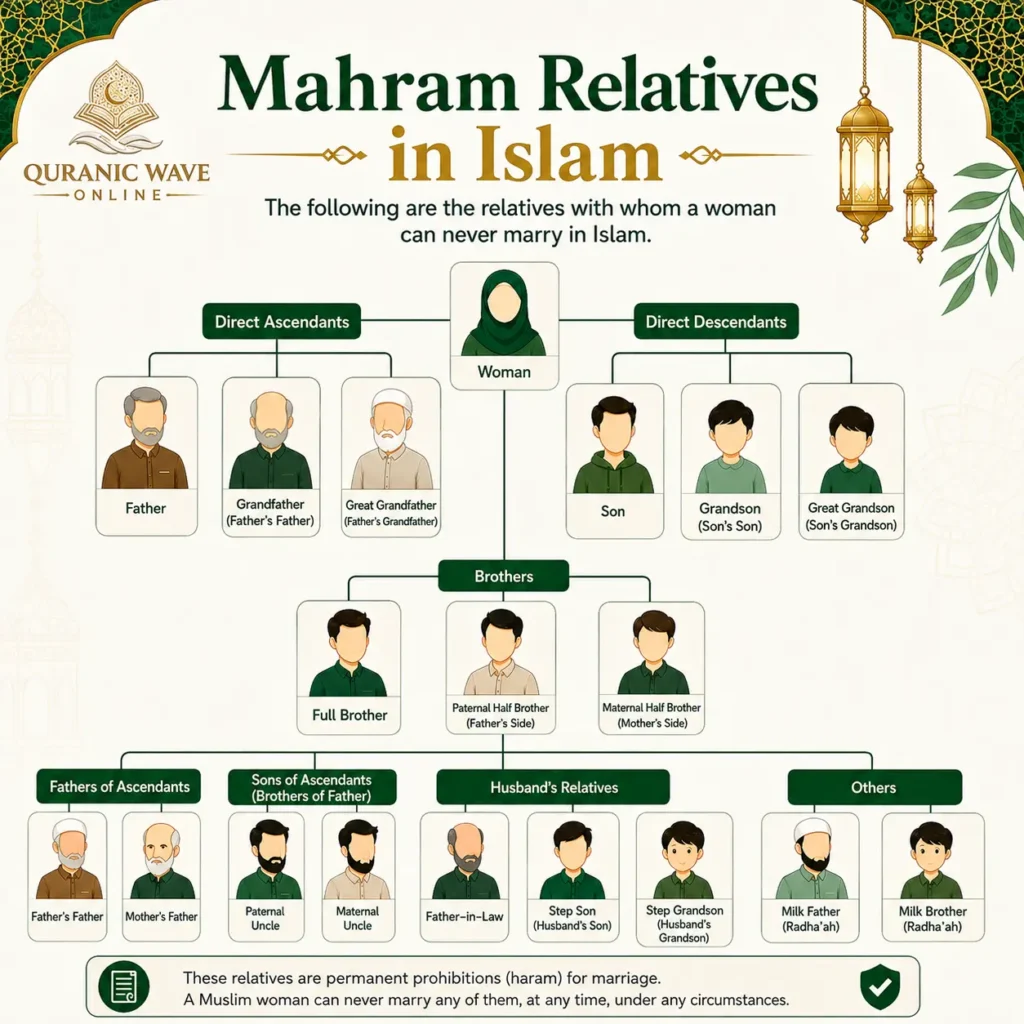
A Mahram is any relative whom a person is permanently prohibited from marrying due to blood, milk kinship (rada’ah), or marriage ties (musaaharah).
“Prohibited to you [for marriage] are your mothers, your daughters, your sisters, your father’s sisters, your mother’s sisters, your brother’s daughters, your sister’s daughters, your [milk] mothers who nursed you, your sisters through nursing, your wives’ mothers, and your stepdaughters…”— [Surah An-Nisa 4:23]
-
By Blood: Father, grandfather, son, grandson, brother, paternal/maternal uncles, and nephews.
-
By Marriage: Father-in-law, stepson, and stepfather (after consummation).
-
By Breastfeeding: Foster brother, foster father, etc., under valid Islamic conditions.
Mahram Does Not Mean “No Rules”
This distinction is essential.
Being Mahram means that marriage between the two is permanently prohibited. It does not mean:
- complete exposure of the body
- exposing the private parts
- staring at the `awrah
- inappropriate touching
- inappropriate joking or speech
- deliberately looking with desire
- behaving in an unchaste manner
- abandoning haya and dignity
- ignoring privacy inside the home
The Qur’an and Sunnah establish modesty as a general Islamic principle.
The Qur’an’s Foundation: Lowering the Gaze and Guarding Modesty
Allah says:
“Tell the believing men to lower their gaze and guard their private parts. That is purer for them.”
Qur’an 24:30
Allah then addresses believing women:
“And tell the believing women to lower their gaze and guard their private parts…”
Qur’an 24:31
The verse then identifies categories of people before whom a woman may display certain adornment, including her father, sons, brothers, nephews and others.
The important point is that the verse begins with lowering the gaze and guarding chastity before mentioning the exceptions concerning whom adornment may be shown.
Therefore, being a Mahram does not cancel the command of haya.
What Are the Islamic Limits for a Father and Daughter?
A father is one of the closest Mahrams of his daughter. A daughter does not observe the same hijab requirements in front of her father that she observes before a non-Mahram man.
Father and daughter may share normal family life, eat meals, converse, travel, and express affectionate care without outer hijab.
However, being Mahram does not make every form of exposure or touching permissible.
Essential Boundaries for a Daughter Around Her Father
“…. that they should not display their beauty and ornaments except what (must ordinarily) appear thereof…”— [Surah An-Nur 24:31]
-
Cover Primary Awrah: She must never intentionally expose the area between her navel and knees.
-
Wear Respectful Attire: Avoid excessively tight or revealing clothing that compromises basic Islamic decorum.
-
Maintain Personal Privacy: Change clothes privately and observe proper boundaries when entering bedrooms during resting hours.
Can a Father See His Daughter’s Hair, Arms or Feet?
The Qur’an permits a woman to display certain adornment before her father and other unmarriageable kin.
Therefore, the rules governing a daughter’s hair, face and ordinary household appearance before her father are not identical to the rules before a non-Mahram man.
However, this permission should not be interpreted as permission for deliberate exposure of the `awrah or intimate areas.
Islamic modesty remains relevant.
A practical principle is:
Normal household appearance is one thing; deliberate exposure of private areas is another.
The same principle applies to mothers, sons and siblings.
What Are the Islamic Limits for a Son and Mother?
A son is a permanent Mahram to his mother.
A mother does not have to observe non-Mahram hijab before her son in the same way that she would before an unrelated man. Qur’an 24:31 establishes the special position of close relatives and includes sons among those before whom a woman may display adornment.
Normal family interaction is therefore permissible.
A mother and son enjoy normal household interactions, sharing meals, conversations, and everyday care, while gradually prioritizing privacy as the son matures.
But as the son grows older—particularly after puberty—privacy and haya become increasingly important.
The son must not stare at his mother’s private areas, and the mother must not deliberately expose them to him.
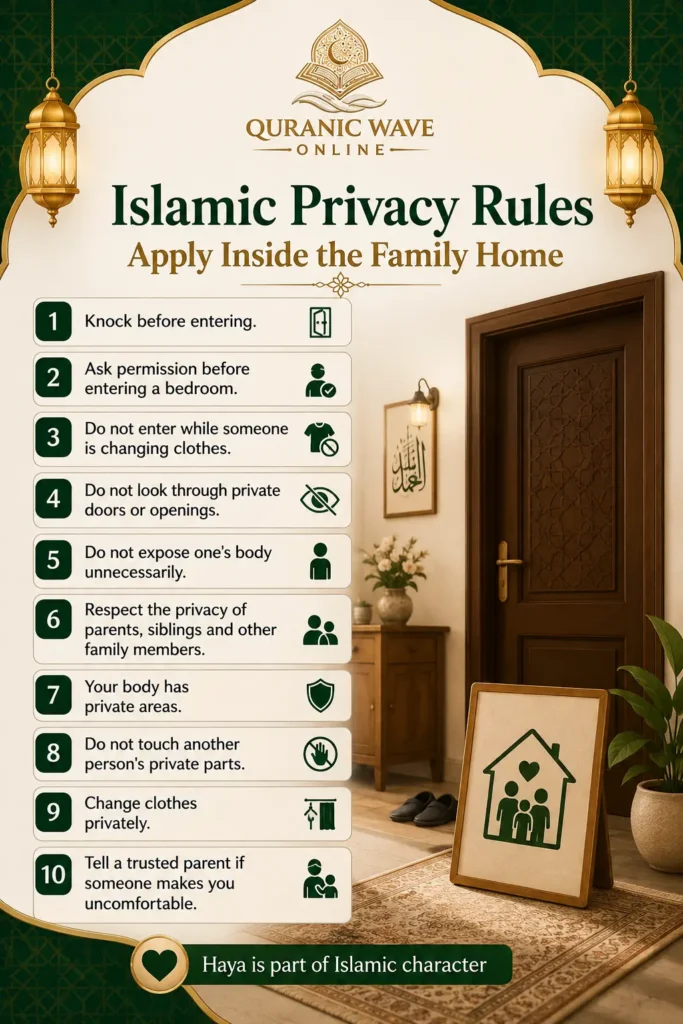
Islamic Privacy Rules Apply Inside the Family Home
One of the clearest proofs that family members do not have unlimited access to one another’s private situations is found in Surah An-Nur 24:58.
Allah commands that children who have not reached puberty should ask permission at certain private times:
- before Fajr
- around midday when people remove their clothes for rest
- after Isha
Allah describes these as three times of privacy.
This teaches an important principle:
Family members need privacy too.
If children are instructed to seek permission before entering at private times, then Islamic family life clearly recognizes personal privacy.
Parents should therefore teach children from an early age:
- Knock before entering.
- Ask permission before entering a bedroom.
- Do not enter while someone is changing clothes.
- Do not look through private doors or openings.
- Do not expose one’s body unnecessarily.
- Respect the privacy of parents, siblings and other family members.
- Your body has private areas.
- Do not touch another person’s private parts.
- Change clothes privately.
- Tell a trusted parent if someone makes you uncomfortable.
- Haya is part of Islamic character.
These manners become even more important after puberty.
What Are the Islamic Limits Between Brother and Sister?
A brother and sister are permanent unmarriageable kin to one another.
This means they are not required to observe the same hijab restrictions that apply between a woman and a non-Mahram man.
The Qur’an explicitly mentions brothers among the people before whom a woman may display certain adornment.
Therefore, ordinary family interaction is permissible.
A brother and sister may:
- Talk normally.
- Eat together.
- Travel with family.
- Sit together in the home.
- Help one another.
- Show normal family affection.
- Hug appropriately as siblings.
But brother-sister Mahram status does not make improper behavior permissible.
A brother cannot deliberately stare at his sister’s private areas. A sister cannot deliberately expose herself to her brother.Inappropriate touching, lustful contact and unchaste behavior is not transformed into permissible actions merely because the people are related.
The Prophet ﷺ Warned Against the “Zina” of the Senses
This is particularly important when discussing boundaries between Mahrams.
Abu Hurayrah رضي الله عنه narrated that the Prophet ﷺ said that the son of Adam has a share of zina, and he described the zina of the eyes as looking, the zina of the tongue as speaking, and the heart as desiring. Another authentic wording mentions the ears, tongue, hand and feet as well. Sahih Muslim 2657–2658
This does not mean that every ordinary look at a family member is zina.
Rather, the warning concerns lustful and prohibited behavior and demonstrates how seriously Islam treats the steps that can lead toward moral transgression.
Is Touching a Close Kin Relative Permissible?
Ordinary familial affection is fundamentally different from unchaste touching.
A father may show normal affection to his daughter. A mother may embrace her son. Brothers and sisters may show ordinary family affection.
The issue changes when physical contact becomes lustful, inappropriate or connected to desire.
The Prophet ﷺ described the hand as having its own share of zina when it engages in prohibited touching.
Therefore:
| Situation | General Islamic principle |
|---|---|
| Parent hugging child affectionately | Permissible |
| Brother/sister normal family affection | Permissible |
| Helping an injured family member | Permissible according to need |
| Caring for a sick relative | Permissible according to need |
| Deliberate exposure of `awrah | Not permissible |
| Lustful touching | Not permissible |
| Unchaste touching | Not permissible |
| Looking at private parts without legitimate need | Not permissible |
| Medical examination | Permitted according to genuine need and appropriate limits |
What About Bathing or Changing Clothes in Front of a Mahram?
Mahram status does not grant unrestricted physical access or permission for complete body exposure. Changing clothes or bathing in front of adult mahrams—whether parents, adult children, or siblings—is strictly prohibited, as everyone must safeguard their primary ‘awrah (navel to knee for men, and chest to knees/feet in household settings for women).
Allah explicitly commands in the Qur’an:
“And do not approach indecencies (al-fawāḥish)—whether open or secret.”
— [Surah Al-An’am 6:151]
Maintaining these personal boundaries within the household directly reflects inner faith. The Prophet ﷺ emphasized the essential role of modesty in a believer’s life:
“Modesty (Haya) is a branch of faith.”
— [Sahih al-Bukhari 9 & Sahih Muslim 35]
The Prophet ﷺ taught people to protect their intimate areas. In an authentic narration, he instructed that the awrah should be covered and emphasized modesty before Allah as well.
Islamic Guidelines on a Father Bathing or Changing a Young Girl
- General Rule (Even Under 7 Years): When the mother (or a female caregiver) is present and capable, the routine bathing and changing of a young daughter should be managed by females. To prevent any potential impropriety or breach of Islamic decorum (sadd-udh-dhara’i’ — blocking the means to wrong) and to instill early privacy (haya), a father should refrain from handling these tasks—even during early childhood—unless necessary.
-
Strict Principle of Precaution: Establishing strict modesty boundaries early on protects the child’s natural sense of privacy and prevents any potential avenues of harm or impropriety within the household.
-
Rare & Exceptional Circumstances: A father is permitted to assist with a young girl’s bathing or dressing only under compelling necessity (darurah), such as:
-
Absolute absence, illness, or physical incapacity of the mother and female relatives.
-
Emergencies or medical conditions requiring immediate parental intervention.
-
-
Mandatory Rules in Exceptional Cases:
-
Limit Exposure: Uncover only the minimum body area strictly required to clean or assist her.
-
Avoid Direct Contact: Use a washcloth or gloves to avoid direct physical contact when cleaning covered body zones (‘awrah).
-
Maintain Decorum: Ensure primary bodily boundaries remain shielded with a towel or cloth to the maximum extent possible during care.
-
The Importance of Haya Between Mahrams
Haya is not limited to relationships between strangers.
Islam encourages modesty throughout a believer’s life.
The Prophet ﷺ said:
“If you feel no shame, then do whatever you wish.”
Sahih al-Bukhari —
Lowering the Gaze Is Not Only for Non-Mahrams
While mahram status grants freedom from observing outer hijab, I often remind my students that it does not offer a free pass for uncontrolled, casual staring inside the household.
The Qur’an emphasizes that every sense is held accountable before Allah:
“Indeed, the hearing, the sight, and the heart—about all those, one will be questioned.”
— [Surah Al-Isra 17:36]
When an unexpected situation occurs within the home, the Prophet ﷺ explicitly guided how to protect individual privacy:
Jarir bin ‘Abdullah reported: “I asked the Messenger of Allah ﷺ about an accidental glance, and he commanded me to turn my gaze away.”
— [Sahih Muslim 2159]
What About Accidental Exposure?
Islam distinguishes between deliberate behavior and something that happens accidentally.
If someone accidentally sees a private part because clothing slips, a person changes unexpectedly, or a door opens without warning, the correct response is to look away and protect the person’s privacy.
Can a Father, Son or Brother Be Alone With a Female Mahram?
Yes. The prohibition of khalwah between a man and a woman who are non-Mahrams does not apply in the same way to a genuine Mahram relationship.
The Prophet ﷺ said:
“No man should stay with a lady in seclusion except in the presence of a Dhu-Mahram.”
Sahih al-Bukhari 5233
Father, Son and Brother: Quick Comparison
| Relationship | Mahram? | Same hijab as before non-Mahram? | `Awrah still protected? | Normal affection |
|---|---|---|---|---|
| Father & daughter | Yes | No | Yes | Permissible |
| Mother & son | Yes | No | Yes | Permissible |
| Brother & sister | Yes | No | Yes | Permissible |
| Father & adult daughter | Yes | No | Yes | Permissible |
| Adult son & mother | Yes | No | Yes | Permissible |
| Brother & adult sister | Yes | No | Yes | Permissible |
| Male cousin & female cousin | No | Yes | Yes | Subject to non-Mahram rules |
| Husband’s brother & wife | No | Yes | Yes | Subject to non-Mahram rules |
| Sister’s husband & sister-in-law | No | Yes | Yes | Subject to non-Mahram rules |
Are There Situations Where Looking or Touching Is Permitted?
Yes, genuine need can change the ruling within its proper limits.
For example:
Medical Treatment
A doctor or family caregiver may need to see or touch a particular part of the body for treatment.
The exposure should be limited to what is necessary.
Caring for an Elderly or Disabled Person
A family member may need to help someone who cannot dress, bathe or move independently.
The assistance should remain within the requirements of the need.
Emergencies
An accident or medical emergency can require immediate assistance.
Islam does not demand that a person abandon someone in danger simply because normally the body should remain covered.
Young Children
Young children naturally require help with bathing, dressing and hygiene.
As they grow and become aware of private matters, they should gradually be taught privacy and permission, consistent with the Qur’anic guidance in Surah An-Nur 24:58.
Common Misunderstandings About Mahram Relatives
“He Is My Brother, So I Can Do Anything in Front of Him.”
No.
A brother is a Mahram, so the hijab requirements are different from those before a non-Mahram.
“She Is My Mother, So Looking at Her Private Parts Is Fine.”
No.
The Prophet ﷺ prohibited looking at the private parts.
“A Father Can See Everything Because He Is a Mahram.”
Mahram status does not mean unrestricted exposure.
Normal household appearance is different from deliberately exposing private parts.
“A Brother Can Touch His Sister However He Wants.”
No.
Normal sibling affection is one matter. Lustful or improper touching is another.
“Cousins Are Basically Brothers and Sisters.”
Islamically, this is incorrect.
A cousin is generally non-Mahram and remains marriageable, so the rules of interaction are different.
“Haya Is Only Necessary Around Strangers.”
No.
Islamic decorum is part of Muslim character, and Islamic texts establish privacy and modesty even within the household.
Frequently Asked Questions About Mahram Limits
What are the Islamic limits for Mahram relatives?
Mahram relatives enjoy relaxed hijab rules, but must still guard their covered zones, avoid lustful gaze or touch, and maintain household modesty.
Can a woman remove her hijab in front of her father?
Yes, a woman may uncover her hair and dress naturally around her father (Surah An-Nur 24:31), provided she maintains general household modesty and covers her primary ‘awrah.
Can a mother be alone with her adult son?
Yes; as permanent close relatives, seclusion (khalwah) rules do not apply, though basic household modesty and privacy guidelines still remain.
Can a brother see his sister without hijab?
Yes, a sister may uncover her hair and wear normal household attire around her brother, provided she covers her primary private parts and maintains general modesty.
Can a father see his daughter’s body?
A father may see his daughter in normal, modest household attire (hair, neck, arms, and feet exposed), but deliberate exposure of her primary bodily boundaries (navel to knee) is strictly forbidden.
Is hugging a Mahram allowed in Islam?
Normal family affection such as an appropriate hug between a parent and child is permissible. The situation is different if touching is sexual, lustful or inappropriate.
Is it haram to look at a Mahram’s private parts?
Deliberately looking at another person’s awrah is prohibited. The Prophet ﷺ explicitly prohibited looking at the private parts.
What if someone accidentally sees a Mahram’s private area?
If the exposure is accidental, the person should immediately look away and protect the relative’s privacy rather than deliberately continuing to look.
Final Takeaway: Mahram Does Not Mean Boundaries Disappear
Islam creates a balanced system for family relationships.
A father can love his daughter.
A mother can care for her son.
A brother can support his sister.
A daughter can sit comfortably with her father.
A son can care for his mother.
These are normal and honorable family relationships.
In my work guiding families on Islamic conduct, I always emphasize that while mahram status lifts marriage prohibitions and relaxes outer hijab, it never cancels modesty (haya), bodily boundaries, or household privacy. Islam fosters warm, honorable family bonds while ensuring dignity and spiritual purity remain intact behind closed doors.