
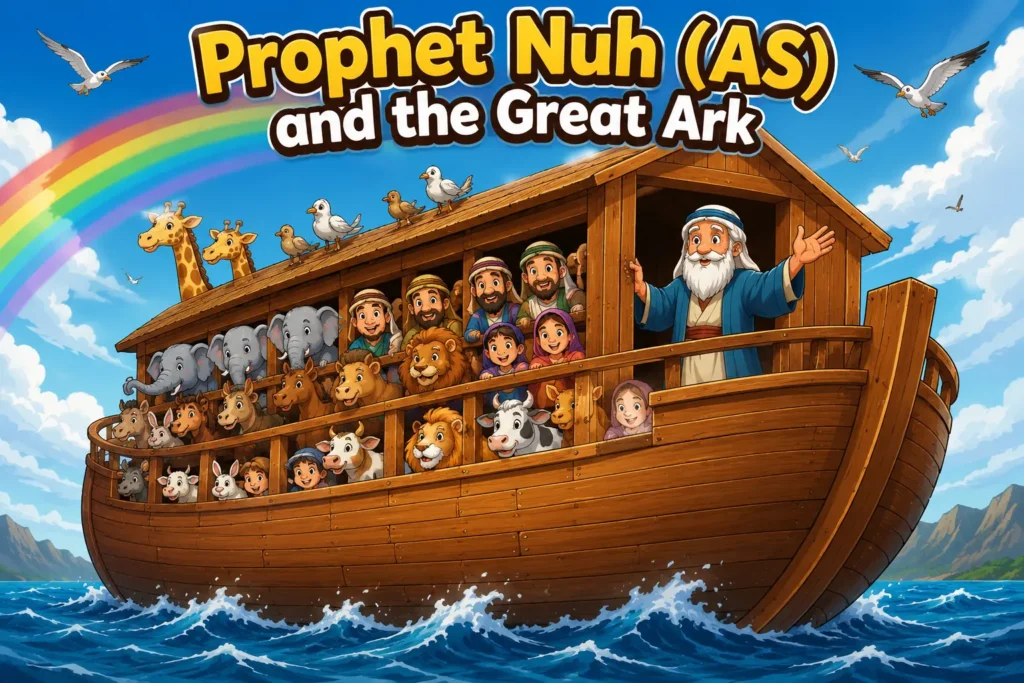
Long, long ago, Allah sent Prophet Nuh (AS) to guide his people.
The people had forgotten Allah. They worshipped idols instead of worshipping their Creator.
Prophet Nuh (AS) gently called them back to Allah. He taught them to worship Allah alone and leave the idols. He invited them during the day and night. He kept trying with great patience for 950 years.
But many people refused to listen. They laughed at Nuh (AS). They mocked him and continued doing wrong things.
Still, Nuh (AS) did not give up.
After many centuries, Allah told Nuh (AS) that a great flood would come. Allah commanded him to build a huge wooden ark.
Nuh (AS) obeyed Allah. He built the ark, even though people laughed at him again.
Then the rain began to fall. Water came from everywhere. The flood became very large!

Nuh (AS), the believers, and the animals that Allah commanded him to take aboard were safe inside the ark. The people who refused to believe were lost in the flood.
When the flood was over, Allah’s command was fulfilled. The ark came to rest, and the believers were safe.
Prophet Nuh (AS) teaches us a beautiful lesson: Be patient, obey Allah, and always trust Him.
🌟 Key Moral Lesson:
Allah is our Creator, and we should worship Him alone. Always stay patient and trust Allah’s command.
🤲 Dua Corner:
بِسْمِ اللَّهِ مَجْرَاهَا وَمُرْسَاهَا
Bismillāhi majrāhā wa mursāhā
Meaning: “In the Name of Allah is its sailing and its anchoring.”
— Surah Hud 11:41
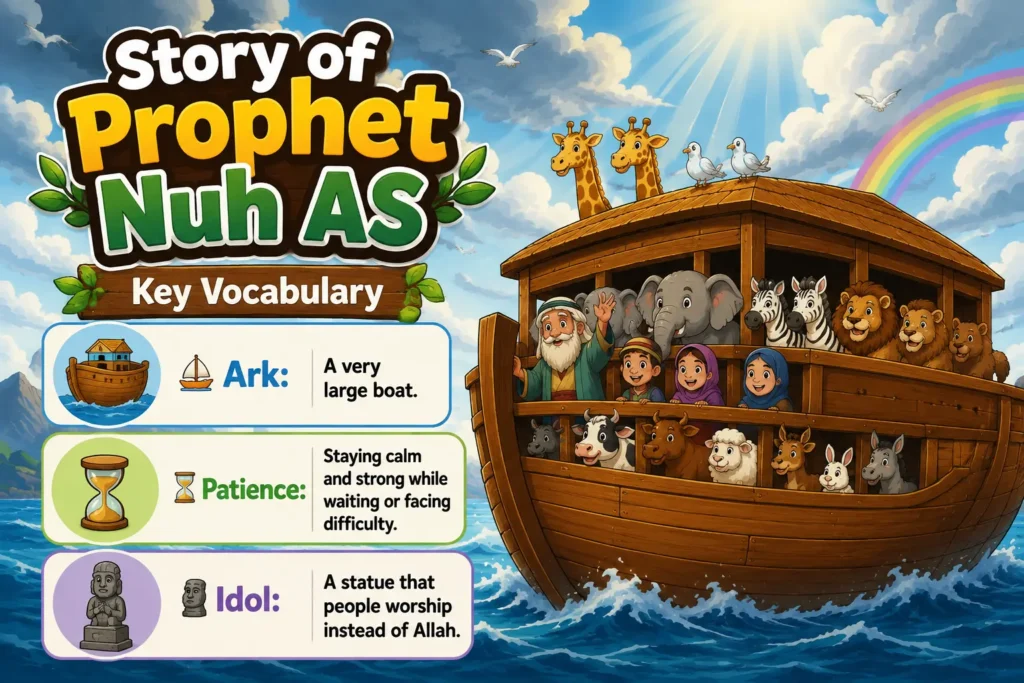
📚 Vocabulary Corner:
⛵ Ark: A very large boat.
⏳ Patience: Staying calm and strong while waiting or facing difficulty.
🗿 Idol: A statue that people worship instead of Allah.
❓ Kid Question:
What did Prophet Nuh (AS) do when people laughed at him—did he give up or stay patient?
Parent & Educator Guide
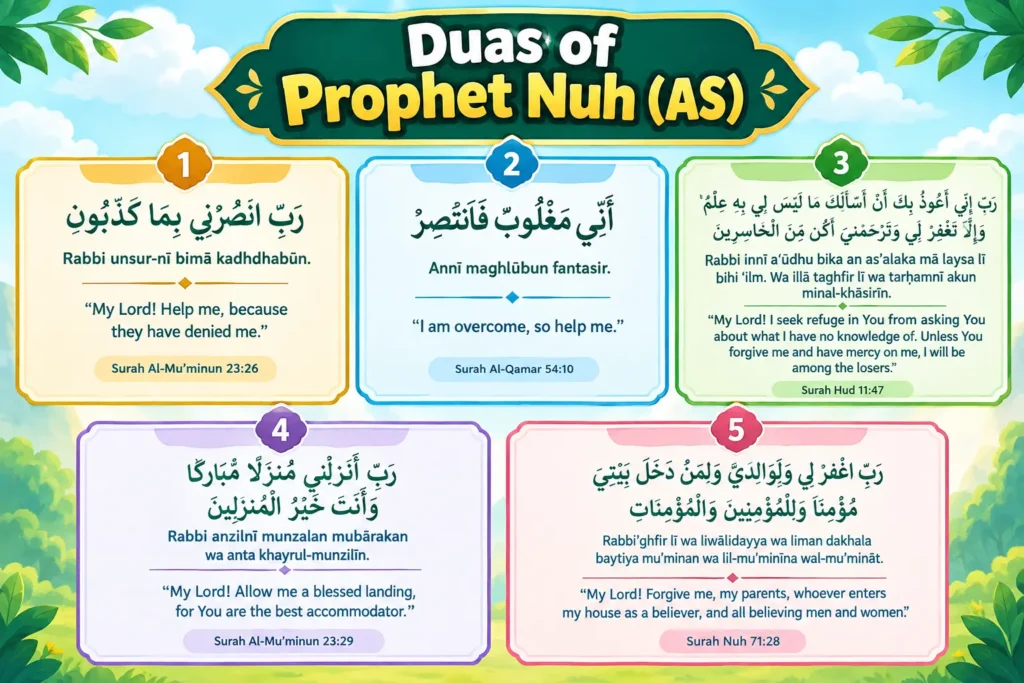
8 Quranic Duas of Prophet Nuh (AS)
1. Dua for Help
Arabic:
رَبِّ انصُرْنِي بِمَا كَذَّبُونِ
Transliteration:
Rabbi unsur-nī bimā kadhdhabūn.
Meaning:
“My Lord! Help me, because they have denied me.”
Reference: Surah Al-Mu’minun 23:26.
2. Dua When Overcome
Arabic:
أَنِّي مَغْلُوبٌ فَانتَصِرْ
Transliteration:
Annī maghlūbun fantasir.
Meaning:
“I am overcome, so help me.”
Reference: Surah Al-Qamar 54:10.
3. Dua for Judgment and Rescue
Arabic:
رَبِّ إِنَّ قَوْمِي كَذَّبُونِ فَافْتَحْ بَيْنِي وَبَيْنَهُمْ فَتْحًا وَنَجِّنِي وَمَن مَّعِيَ مِنَ الْمُؤْمِنِينَ
Transliteration:
Rabbi inna qawmī kadhdhabūn. Fāftaḥ baynī wa baynahum fatḥan wa najjinī wa man ma‘iya minal-mu’minīn.
Meaning:
“My Lord! My people have rejected me. So judge between me and them decisively, and save me and the believers with me.”
Reference: Surah Ash-Shu‘ara 26:117–118.
4. Dua of Seeking Forgiveness and Mercy
Arabic:
رَبِّ إِنِّي أَعُوذُ بِكَ أَنْ أَسْأَلَكَ مَا لَيْسَ لِي بِهِ عِلْمٌ ۖ وَإِلَّا تَغْفِرْ لِي وَتَرْحَمْنِي أَكُن مِّنَ الْخَاسِرِينَ
Transliteration:
Rabbi innī a‘ūdhu bika an as’alaka mā laysa lī bihi ‘ilm. Wa illā taghfir lī wa tarḥamnī akun minal-khāsirīn.
Meaning:
“My Lord! I seek refuge in You from asking You about what I have no knowledge of. Unless You forgive me and have mercy on me, I will be among the losers.”
Reference: Surah Hud 11:47.
5. Dua When Boarding the Ark
Arabic:
بِسْمِ اللَّهِ مَجْرَاهَا وَمُرْسَاهَا ۚ إِنَّ رَبِّي لَغَفُورٌ رَّحِيمٌ
Transliteration:
Bismillāhi majrāhā wa mursāhā. Inna rabbī laghafūrun raḥīm.
Meaning:
“In the Name of Allah is its sailing and its anchoring. Surely my Lord is All-Forgiving, Most Merciful.”
Reference: Surah Hud 11:41
6. Dua for a Blessed Landing
Arabic:
رَّبِّ أَنزِلْنِي مُنزَلًا مُّبَارَكًا وَأَنتَ خَيْرُ الْمُنزِلِينَ
Transliteration:
Rabbi anzilnī munzalan mubārakan wa anta khayrul-munzilīn.
Meaning:
“My Lord! Allow me a blessed landing, for You are the best accommodator.”
Reference: Surah Al-Mu’minun 23:29.
7. Dua for the Believers
Arabic:
رَّبِّ اغْفِرْ لِي وَلِوَالِدَيَّ وَلِمَن دَخَلَ بَيْتِيَ مُؤْمِنًا وَلِلْمُؤْمِنِينَ وَالْمُؤْمِنَاتِ
Transliteration:
Rabbi’ghfir lī wa liwālidayya wa liman dakhala baytiya mu’minan wa lil-mu’minīna wal-mu’mināt.
Meaning:
“My Lord! Forgive me, my parents, whoever enters my house as a believer, and all believing men and women.”
Reference: Surah Nuh 71:28.
8. Dua Against the Persistent Wrongdoers
Arabic:
رَّبِّ لَا تَذَرْ عَلَى الْأَرْضِ مِنَ الْكَافِرِينَ دَيَّارًا
Transliteration:
Rabbi lā tadhar ‘alal-arḍi minal-kāfirīna dayyārā.
Meaning:
“My Lord! Do not leave upon the earth any of the disbelievers.”
Reference: Surah Nuh 71:26.
This was a special supplication after Nuh (AS) had spent centuries calling his people to Allah and they continued in rejection. The following verses explain why he made this prayer.
3 Talking Points for Parents & Educators
1. Why did the flood happen?
The flood was not simply because people made ordinary mistakes. Prophet Nuh (AS) called his people to Allah for 950 years, yet they continued rejecting the truth, worshipping idols, and persisting in wrongdoing. The Quran describes the flood as punishment for their sins.
2. What does Allah’s justice teach us?
Allah is perfectly just. The story teaches children that Allah gives people opportunities to turn back to Him, but persistent rejection and wrongdoing have consequences.
3. What should children learn from Nuh (AS)?
Children can learn patience, obedience, courage, and trust in Allah. Nuh (AS) continued doing what Allah commanded even when people laughed at him.
2 Simple Activities
🎨 Activity 1 — Draw the Ark
Ask children to draw a large wooden ark with water around it. They can add pairs of animals and believers inside. Then ask: “What made the people in the ark safe?”
🤲 Activity 2 — Dua Recitation Match
Write short parts of the duas on separate cards. Let children match the Arabic card with its transliteration and simple English meaning. Start with the easy dua: Bismillāhi majrāhā wa mursāhā.
Enjoyed this story? Continue your journey through the lives of the Prophets by exploring The Story of Prophet Ibrahim (AS) and The Story of Prophet Idris (AS) to discover inspiring lessons of faith, patience, and devotion!
Pingback: Prophet Ibrahim (AS) Story for Kids: The Miracle & Duas
Pingback: Prophet Yaqub (AS) Story in English: Lessons, Duas & Facts