
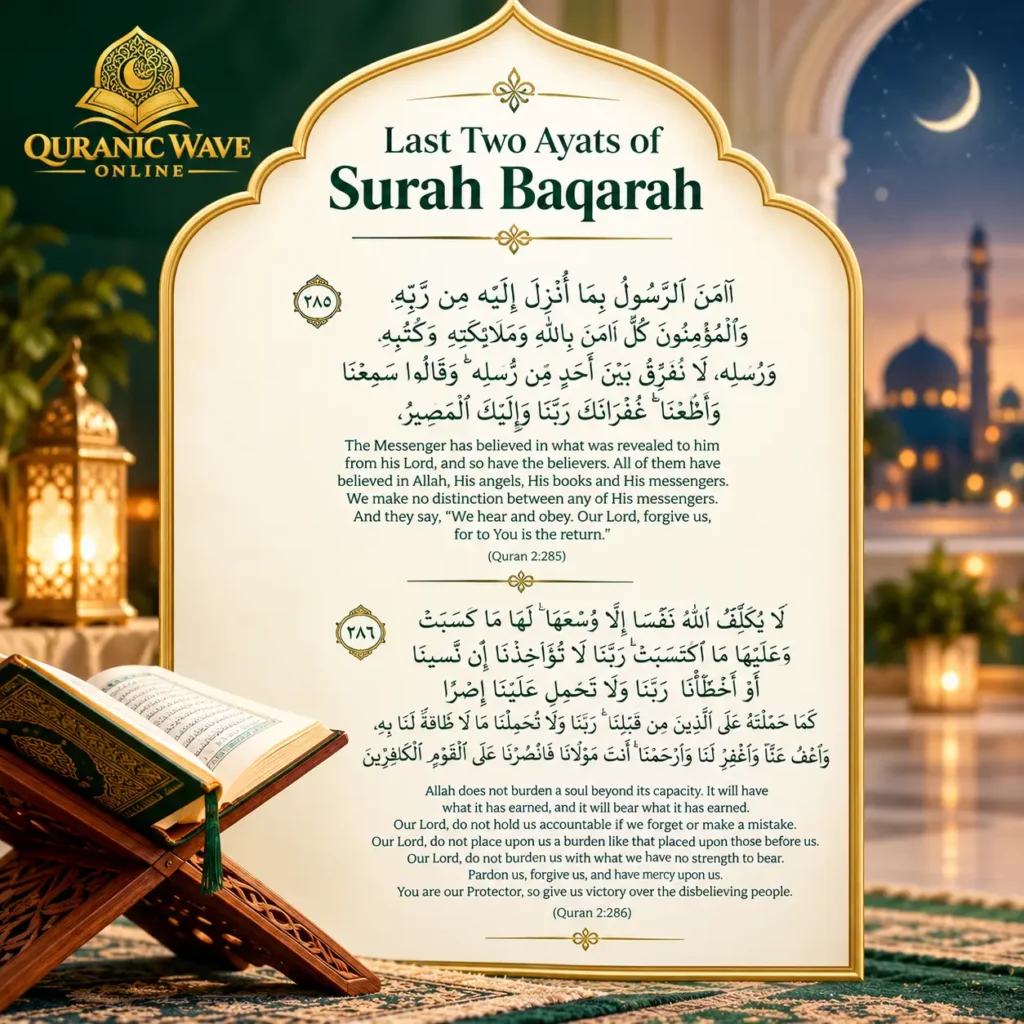
Whenever I wind down for the night, I always try to set aside a quiet moment for final prayers, gratitude, and the remembrance of Allah. One of my favorite, most comforting practices to include in this nightly routine is reciting the last two ayats of Surah Baqarah (Quran 2:285–286).
To me, these verses feel like a heavenly gift sent straight from Allah to Prophet Muhammad ﷺ during the miraculous night journey. They contain essential Islamic beliefs, sincere supplications, and a powerful reminder of Allah’s mercy. Their special virtue is also established in an authentic hadith of Prophet Muhammad ﷺ.
Whether you already have them memorized or are still learning like I did, understanding their deep meaning can completely transform your nightly routine.
1. An Authentic Hadith About the Last Two Ayats of Surah Baqarah
The most direct reason to recite these verses at night comes from an authentic narration.
The Prophet Muhammad ﷺ said:
“Whoever recites the last two verses of Surah Al-Baqarah at night, they will suffice him.”
Reference: Sahih al-Bukhari 5009; Sahih Muslim 808.
This hadith highlights a special virtue associated with reciting these two verses at night. Scholars have discussed what “they will suffice him” means, including interpretations related to protection, spiritual sufficiency, or being sufficient in place of additional night recitation.
The exact interpretation is not stated explicitly in the hadith, so it is best not to restrict its meaning to just one explanation.
The important lesson is clear: the last two verses of Surah Baqarah hold a special place in the Prophet’s ﷺ guidance for the night.
Before you close your eyes and wind down for the night, wrapping yourself in the peace of specific nightly supplications makes all the difference. I put together a complete guide on the Adhkar Before Sleep: Adhkar Before Sleep: 10 Authentic Duas for Protection & Peace to help you end your day with maximum spiritual protection and tranquility.
2. They Strengthen Your Faith in Allah
The last two ayats begin by describing the faith of the Messenger and the believers.
Quran 2:285 (part of the verse):
آمَنَ الرَّسُولُ بِمَا أُنْزِلَ إِلَيْهِ مِنْ رَبِّهِ وَالْمُؤْمِنُونَ
Meaning: “The Messenger has believed in what was revealed to him from his Lord, and so have the believers.”
The verse affirms belief in Allah, His angels, His revealed books, and His messengers. It also teaches believers to hear and obey Allah’s guidance.
Reciting this verse before sleep offers an opportunity to reflect on the foundations of Islamic faith. Rather than rushing through the words, take a moment to remember what you believe and renew your intention to follow Allah’s guidance.
3. They Remind You That Allah Does Not Burden a Soul Beyond Its Capacity
One of the most reassuring statements in the Quran appears in Surah Baqarah 2:286:
لَا يُكَلِّفُ اللَّهُ نَفْسًا إِلَّا وُسْعَهَا
Meaning: “Allah does not burden a soul beyond its capacity.”
This verse reminds Muslims that Allah knows the limits and circumstances of every soul. It can bring comfort to someone facing difficulties, responsibilities, or uncertainty.
However, it does not mean that life will always be easy or that hardship will disappear immediately. Instead, it encourages believers to trust Allah while continuing to fulfill their responsibilities, seek appropriate help, and persevere through challenges.
Reading this verse at night can help you end the day by remembering Allah’s knowledge, wisdom, and mercy.
4. They Contain Powerful Duas for Forgiveness and Mercy
The final verse of Surah Baqarah includes several supplications that every Muslim can reflect on.
| Quranic supplication | Meaning |
|---|---|
| رَبَّنَا لَا تُؤَاخِذْنَا إِن نَّسِينَا أَوْ أَخْطَأْنَا | Our Lord, do not hold us accountable if we forget or make a mistake. |
| رَبَّنَا وَلَا تَحْمِلْ عَلَيْنَا إِصْرًا | Our Lord, do not place upon us a burden like that placed upon those before us. |
| وَاعْفُ عَنَّا وَاغْفِرْ لَنَا وَارْحَمْنَا | Pardon us, forgive us, and have mercy upon us. |
Reference: Quran 2:286.
These supplications teach believers to seek forgiveness, ask for mercy, and turn to Allah for help in fulfilling their duties.
The verse also asks Allah for help against overwhelming burdens and for victory over those who oppose the believers. Its closing words direct the heart toward Allah as the ultimate protector and source of support.
5. They Teach a Balanced Approach to Responsibility
The last two verses do more than offer comfort. They also remind believers that each soul is accountable for what it earns.
Quran 2:286 states that a person receives the consequences of the good they earn and bears the consequences of the evil they commit.
This encourages Muslims to reflect on their actions before sleeping. Consider whether you have treated others fairly, fulfilled your responsibilities, or need to seek forgiveness for a mistake.
The verse combines accountability with supplication, teaching that believers should strive to do good while continually asking Allah for forgiveness and assistance.
6. How to Make Reciting These Verses a Nightly Habit
You do not need a complicated routine to begin. Follow these simple steps:
- Choose a regular time: Recite the verses as part of your bedtime routine.
- Learn the Arabic: If you cannot yet read them fluently, practice a few words at a time.
- Understand the meaning: Read a reliable translation alongside the Arabic text.
- Reflect on the duas: Pay attention to the requests for forgiveness, mercy, and help.
- Remain consistent: Build the habit into your nightly remembrance of Allah.
The hadith specifically mentions reciting the verses at night. It does not require a particular number of repetitions beyond the recitation of these two verses.
If you are learning, use a reliable Quran text or qualified teacher to check your pronunciation, and avoid letting the desire for perfect recitation prevent you from beginning.
Frequently Asked Questions
1. What are the last two ayats of Surah Baqarah?
They are Quran 2:285 and 2:286. They discuss faith, obedience to Allah, personal accountability, forgiveness, mercy, and supplication.
2. What is the benefit of reciting the last two ayats of Surah Baqarah at night?
According to Sahih al-Bukhari 5009 and Sahih Muslim 808, whoever recites them at night will find that they suffice him. Scholars have offered different explanations of this statement, including spiritual protection and sufficiency.
3. Should I recite these verses before sleeping?
Yes, reciting them at night is an established Sunnah practice based on the authentic hadith. You can include them in your regular bedtime routine.
4. Can I recite the last two ayats of Surah Baqarah without memorizing them?
Yes. You may read them from a reliable Quran or mushaf while learning. Gradually practicing their Arabic, pronunciation, and meaning can help you memorize them over time.
5. Do I need to recite them three times?
The cited hadith does not prescribe three repetitions. It mentions reciting the last two verses at night, so there is no need to add a specific repetition count based on this narration.
Make These Two Verses Part of Your Night
The last two ayats of Surah Baqarah bring together faith, accountability, trust in Allah, and heartfelt supplication. Their virtue is supported by an authentic hadith, making them a meaningful addition to a Muslim’s nightly routine.
Start tonight: Recite Quran 2:285–286, learn their translation, and reflect on the duas they contain. Share these verses with your family and encourage one another to build a consistent connection with the Quran.