
Few moments in a parent’s life compare to that initial spark of happiness when your child makes their very first sounds and speaks those early, sweet words.
But for me, the true doorway to that happiness opened the day my student learned to recognize the Arabic alphabet— unlocking a lifelong connection with the Holy Quran.
This guide explains the Arabic alphabet for beginners in a simple way, with practical lessons that parents can use at home. Whether your child is learning Arabic for Quran reading, Islamic studies, or basic Arabic literacy, these steps can provide a strong foundation.
What Is the Arabic Alphabet?
The Arabic alphabet consists of 28 basic letters. Arabic is written from right to left, unlike English, which is written from left to right.
Children learning Arabic for Quran reading usually begin by recognizing individual letters before moving on to connected letters, vowel sounds, words, and eventually Quranic verses.
Some Arabic letters may look unfamiliar to English-speaking children. Others have similar shapes but differ in their dots or pronunciation.
For example:
- ب — Baa
- ت — Taa
- ث — Thaa
- ن — Noon
- ي — Yaa
Learning to notice the dots is therefore an important early skill.
Arabic Alphabet for Beginners: The 28 Letters
Here is a simple reference for parents and young learners:
| Letter | Name | Approximate Sound |
|---|---|---|
| ا | Alif | Long “aa” or carrier |
| ب | Baa | b |
| ت | Taa | t |
| ث | Thaa | th |
| ج | Jeem | j |
| ح | Haa | Strong breathy h |
| خ | Khaa | Kh |
| د | Daal | d |
| ذ | Dhaal | th |
| ر | Raa | r |
| ز | Zaay | z |
| س | Seen | s |
| ش | Sheen | sh |
| ص | Saad | Heavy s |
| ض | Daad | Heavy d |
| ط | Taa | Heavy t |
| ظ | Zhaa | Heavy dh |
| ع | Ayn | Deep throat sound |
| غ | Ghayn | Gh |
| ف | Faa | f |
| ق | Qaaf | Deep q |
| ك | Kaaf | k |
| ل | Laam | l |
| م | Meem | m |
| ن | Noon | n |
| ه | Haa | h |
| و | Waaw | w / long oo |
| ي | Yaa | y / long ee |
The English sound descriptions are only approximate. Arabic contains sounds that do not have exact equivalents in English, so children should eventually learn pronunciation from a qualified teacher or reliable audio source.
Why Should Children Learn Arabic Letters Before Reading the Quran?
Children who are learning Quran reading need more than memorization. They need to recognize letters, understand how letters connect, and pronounce sounds correctly.
A strong foundation in the Arabic alphabet can help children progress toward:
- Reading Arabic words
- Recognizing Quranic letters
- Learning short vowels
- Understanding letter connections
- Studying any Qaida or another beginner reading method
- Developing correct pronunciation
- Beginning Tajweed lessons later
The goal is not to rush through all 28 letters. Accurate recognition and pronunciation are more useful than simply completing an alphabet chart.

Looking for more ways to engage your young learner? Check out our articles on :
10 Creative Ways to Teach Quran to Kids
A Simple Arabic Alphabet Lesson Plan for Kids
Parents can divide the learning process into small lessons instead of teaching the entire alphabet at once.
Lesson 1: Introduce a Few Letters
Start with three or four letters.
For example:
ا — Alif
ب — Baa
ت — Taa
ث — Thaa
Show each letter clearly. Say its name and sound, then allow the child to repeat it.
Keep the first lesson short. A child who finishes wanting to learn more is often in a better position for the next lesson than a child who feels overwhelmed.
Lesson 2: Focus on Similar Letters
Arabic has groups of letters that share similar shapes.
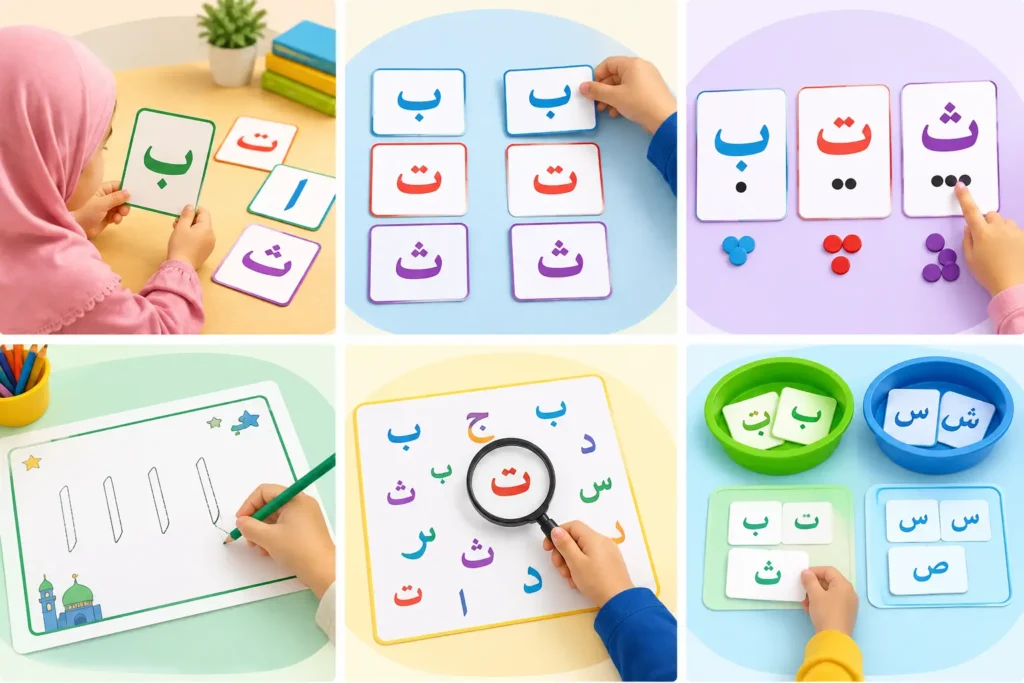
For example:
ب — ت — ث
The basic shape is similar, but the dots are different.
Ask the child:
- Which letter has one dot?
- Which has two dots?
- Which has three dots?
- Can you point to Baa?
- Can you find Thaa?
This turns recognition into an active exercise rather than passive memorization.
Lesson 3: Practice Letter Sounds
Once a child recognizes a letter, introduce its pronunciation.
Parents should avoid teaching an English sound as if it were an exact Arabic equivalent when it is not. Some Arabic sounds require specific positions of the tongue, throat, or mouth.
For Quran reading, this becomes particularly important with letters such as:
- ح
- خ
- ع
- غ
- ص
- ض
- ط
- ظ
- ق
If you are unsure about pronunciation, learning alongside a qualified Quran teacher can be very helpful.
Use Visual Activities to Make Learning Easier
Young children often respond well to activities that allow them to see, touch, say, and identify letters.
Try activities such as:
- Letter cards: Show one Arabic letter and ask the child to name it.
- Matching games: Match identical Arabic letters.
- Dot games: Ask children to count the dots on similar letters.
- Tracing: Let children trace large Arabic letters.
- Find the letter: Place several letters on a page and ask the child to find one specific letter.
- Letter sorting: Group letters according to their similar shapes.
These activities can be adapted according to the child’s age and learning level.
How Parents Can Teach Arabic Letters at Home
You do not have to be an Arabic speaker to support your child’s learning.
A simple routine can work well:
5–10 minutes: Review previous letters
5 minutes: Introduce one new concept
5 minutes: Practice recognition or pronunciation
The exact timing can change according to the child’s age and attention span.
Consistency matters more than making every session long.
Keep Practice Regular
Instead of having one long lesson once a week, consider short practice sessions throughout the week.
For example:
- Monday: Review letters
- Tuesday: Practice pronunciation
- Wednesday: Letter matching
- Thursday: Review
- Friday: Connect letters with Quran reading practice
The routine should remain flexible. If a child is tired or distracted, shorten the session rather than turning learning into a struggle.
Arabic Letters Can Change Shape
One concept that sometimes surprises beginners is that Arabic letters may look different depending on where they appear in a word.
A letter can have:
- An isolated form
- An initial form
- A medial form
- A final form
For example, the letter ب can appear in different connected shapes when it is used within Arabic words.
Children do not necessarily need to master all these forms during their first alphabet lesson. It is usually easier to introduce them after they can confidently recognize the individual letters.
Common Mistakes Parents Should Avoid
Teaching Arabic at home becomes easier when parents know what not to do.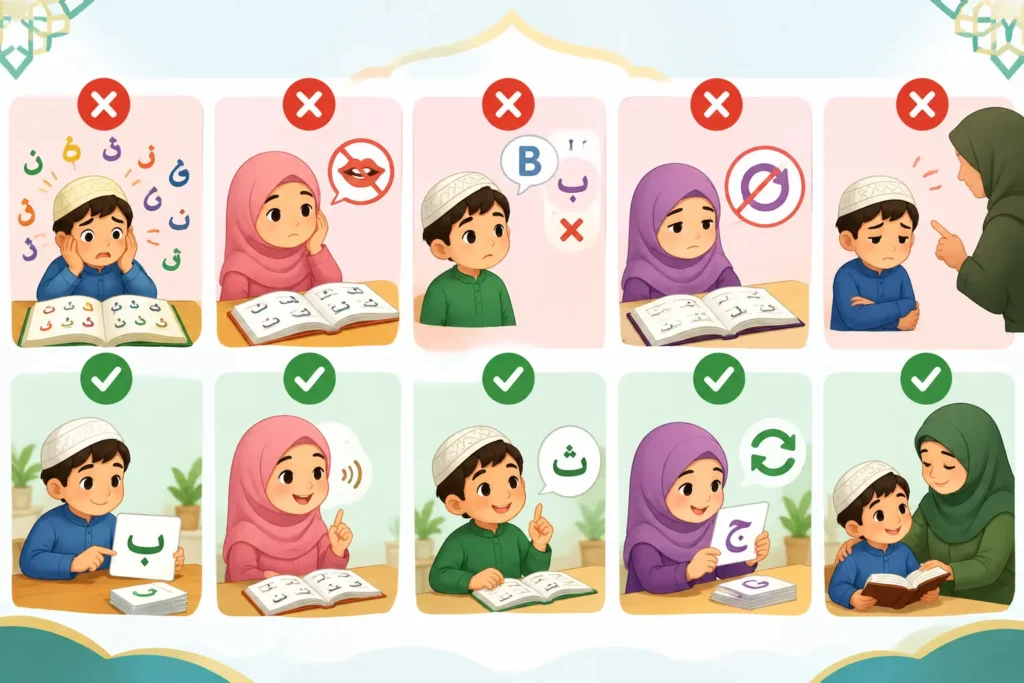
1. Teaching Too Many Letters at Once
Introducing all 28 letters in one sitting may create unnecessary confusion.
2. Ignoring Pronunciation
Letter recognition is only one part of Quran reading. Correct pronunciation should gradually become part of the learning process.
3. Comparing Every Arabic Sound to English
Some Arabic sounds are unique. Forcing them into an English pronunciation can create habits that are difficult to correct later.
4. Moving Forward Without Review
Children need repeated exposure to remember new letters. Review should remain part of every lesson.
5. Using Pressure as Motivation
A child who associates Quran learning with constant pressure may become reluctant to practice. Encouragement, patience, and age-appropriate expectations can create a healthier learning environment.
When Should Children Start Learning the Arabic Alphabet?
There is no single age that works for every child.
Readiness can depend on:
- Attention span
- Interest in letters
- Ability to follow simple instructions
- Language development
- Familiarity with books and writing
- Individual learning pace
Some children enjoy beginning with letters at a young age, while others benefit from waiting until they can comfortably focus on a short lesson.
Parents should focus on readiness rather than comparing one child’s progress with another.
Arabic Alphabet and Noorani Qaida
Many children learning to read the Quran eventually study Noorani Qaida or a similar beginner reading method.
The alphabet provides the starting point. A structured Qaida course can then introduce concepts such as:
- Individual letter recognition
- Letter combinations
- Harakat
- Fathah
- Kasrah
- Dammah
- Sukoon
- Tanween
- Madd
- Basic pronunciation practice
The sequence may differ depending on the teaching method, but the basic purpose is to gradually move a learner from recognizing letters to reading Quranic text.
How Online Quran Classes Can Help
For families who want structured guidance, online Quran classes can provide regular lessons with a teacher.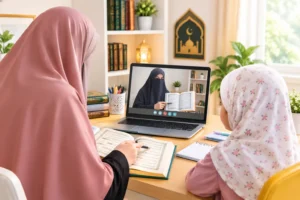
A teacher can listen to a child’s pronunciation, identify recurring mistakes, adjust the lesson level, and provide guided practice.
For young learners, parents can look for classes that offer:
- Age-appropriate teaching
- Short and focused lessons
- Qualified Quran teachers
- Individual attention
- Pronunciation practice
- Regular revision
- Positive communication with parents
Online learning works best when the home environment also supports regular practice.
A Simple Weekly Arabic Alphabet Routine
| Day | Practice |
|---|---|
| Monday | Review 4–5 letters |
| Tuesday | Practice letter sounds |
| Wednesday | Similar-letter activity |
| Thursday | Tracing and recognition |
| Friday | Review everything learned |
| Saturday | Short Quran reading activity |
| Sunday | Rest or light revision |
This is only an example. Parents can adjust the routine according to their child’s age and schedule.
Frequently Asked Questions
How many letters are in the Arabic alphabet?
The Arabic alphabet has 28 basic letters.
What is the best way to teach Arabic letters to children?
Start with a small number of letters, use clear pronunciation, review frequently, and include visual or interactive activities. Gradually introduce connected forms and vowel sounds.
Can parents teach the Arabic alphabet at home?
Yes. Parents can teach basic letter recognition and support practice at home. For accurate Quran pronunciation, however, guidance from a qualified teacher can be valuable.
How long does it take a child to learn the Arabic alphabet?
There is no fixed timeframe. Some children recognize the letters quickly, while others need more repetition. Regular short practice is generally more useful than rushing through the alphabet.
Should children learn Arabic before learning the Quran?
Children learning to read the Quran need familiarity with Arabic letters and their sounds. They do not need to become fluent Arabic speakers before beginning Quran reading.
Is Noorani Qaida necessary for learning the Quran?
No single beginner method is the only possible approach, but Noorani Qaida is widely used as a structured way to develop basic Quran reading skills. A suitable teacher can help choose an approach according to the child’s needs.
Final Thoughts
Learning the Arabic alphabet for beginners should be a gradual journey. Children need time to recognize each letter, distinguish similar shapes, practice unfamiliar sounds, and eventually connect letters into words.
For parents, the most useful approach is simple: keep lessons short, review regularly, correct pronunciation gently, and celebrate steady progress. A child does not need to master everything in a few days.
If your child is beginning Quran reading, start with the alphabet, build a strong foundation, and then progress step by step toward Qaida, fluent reading, and Tajweed.
Ready to help your child begin? Explore structured Quran learning with age-appropriate lessons and consistent guidance at QuranicWave .