
Reading the Quran is one of the greatest acts of worship a Muslim can perform. While many recite its verses daily, understanding the importance of reading Quran with understanding can transform your spiritual journey and bring you closer to Allah. We recite its verses in Salah, during Ramadan, in the morning and evening, and whenever our hearts need guidance.
But there is something that can take our relationship with the Quran to another level: understanding what we are reading.
I personally experienced this change when I started learning the Quran with its meaning. Before that, I could recite many verses, but understanding their message gave those same verses a completely different place in my heart.
Today, when I hear Quran recitation, I can often understand what is being discussed, remember the background, connect the verses with their lessons, and think about what Allah is teaching us.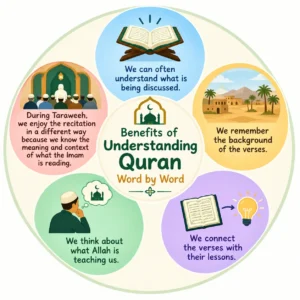
During Taraweeh, for example, I enjoy the recitation in a different way because I know the meaning and context of what the Imam is reading.
Sometimes I even remember particular messages from an ayah when I face a situation in daily life.
This is why learning the Quran with understanding is so valuable. We are not simply reading words. We are learning the message of our Creator.
Why Is Understanding the Quran So Important?
The Quran was revealed as guidance for humanity. Allah says:
“This is a blessed Book which We have revealed to you so that they may contemplate its verses and people of understanding may be mindful.”
Surah Sad 38:29
This verse highlights an important purpose of the Quran: tadabbur, meaning reflection and thoughtful consideration.
Understanding the Quran helps us move from simply reciting its words to thinking about its message.
It can help us ask:
- What is Allah teaching me here?
- What does this ayah tell me about faith?
- What action does Allah want from me?
- What should I avoid?
- What lesson can I take into my daily life?
- How can this guidance change my behavior?
That is where Quranic reading becomes deeply personal.
Reading the Quran With Meaning Changes the Way We Listen
One of the biggest benefits I have personally experienced is that Quran recitation became much more meaningful after learning its translation and context.
When I hear an ayah now, I am not only listening to beautiful Arabic words. I can often recognize the subject, remember the surrounding verses, and understand the lesson being presented.
This became especially noticeable for me during Taraweeh.
When the Imam recites a long portion of the Quran, understanding the meaning allows me to follow the message as it develops.
I can remember the stories, warnings, commands, promises, and lessons instead of hearing the recitation as something completely unfamiliar.
Sometimes one ayah brings back an entire passage or a lesson I learned previously.
That connection is one of the beautiful results of learning the Quran with understanding.
The Quran Calls Us to Reflect
Allah repeatedly encourages people to think deeply about His revelation.
Allah says:
“Do they not then reflect on the Quran?”
Surah An-Nisa 4:82
The Arabic word yatadabbarun is connected with carefully considering and reflecting upon something.
This does not mean that every person should independently invent interpretations of the Quran. Understanding the Quran should be approached with humility, reliable translations, authentic tafsir, and qualified scholarship when deeper interpretation is required.
But every Muslim can benefit from learning the basic meaning and message of the verses.
7 Important Benefits of Understanding the Quran
1. It Helps Us Receive Allah’s Guidance
The Quran contains guidance about belief, worship, character, family life, justice, patience, gratitude, repentance, and many other areas.
If we understand what Allah is telling us, it becomes easier to recognize how those teachings relate to our lives.
For example, reading an ayah about patience with its meaning can make us think about how we respond when life becomes difficult.
The words become guidance rather than simply recitation.
2. It Makes Quran Recitation More Meaningful
Arabic recitation itself is an important act of worship. Learning the meaning does not replace Arabic recitation.
Instead, the two can complement each other.
We can recite the Quran in Arabic while also learning what its verses mean in a language we understand.
This allows the tongue to recite while the mind and heart follow the message.
3. It Helps Us Remember Lessons and Messages
Understanding creates connections.
When I learn why a verse was revealed, what it discusses, and how it connects to the verses around it, I find it much easier to remember the lesson.
Later, when I encounter a similar situation, the ayah can come back to mind.
This has been one of the most useful parts of learning the Quran with meaning for me.
4. It Helps Us Answer Everyday Questions
Another practical benefit I have experienced is being able to quickly locate Quranic guidance when someone asks about a particular subject.
If someone asks about an Islamic ruling or wants to know what Allah says about a certain matter, I can often open the Quran, search for the relevant topic, and say:
“This is where Allah mentions it, in this ayah of this Surah.”
Of course, a single verse should not always be taken out of context to establish a detailed ruling. Islamic rulings can require studying several verses, authentic Sunnah, Arabic language, tafsir, and scholarly explanation.
Still, knowing the Quran’s content makes it much easier to recognize where its guidance can be found.
5. It Deepens Our Connection With Allah
Imagine receiving a letter from someone you love but never understanding what it says.
You may appreciate the letter itself, but knowing its message allows you to appreciate it on another level.
The Quran is Allah’s revelation. Understanding its message helps us learn about Allah, His commands, His mercy, His warnings, His promises, and the qualities He loves.
6. It Makes Stories More Relevant
The Quran contains the stories of many prophets and previous nations.
When we understand these stories, we can see that they are not simply historical accounts.
They contain lessons about:
- Patience
- Tawakkul
- Repentance
- Obedience
- Gratitude
- Courage
- Forgiveness
- Trust in Allah
Understanding the surrounding verses also helps us recognize why a particular story is being mentioned.
7. It Encourages Action
Knowledge becomes especially valuable when it changes our actions.
If I read about forgiveness and understand the message, I should think about whether I am holding unnecessary grudges.
If I read about gratitude, I should examine whether I appreciate Allah’s blessings.
If I read about honesty, I should consider my own speech and dealings.
This is one reason understanding matters: it gives us something to act upon.
Reading the Quran in Arabic and Understanding Its Meaning
A common question is:
“Is reading the Quran in Arabic still valuable if I do not understand Arabic?”
Yes.
A Muslim should continue reciting the Quran in Arabic while making an effort to understand its meaning.
The Prophet Muhammad ﷺ taught the virtue of Quran recitation. In a well-known hadith, he said that whoever recites a letter from the Book of Allah receives a good deed multiplied tenfold, explaining that “Alif-Lam-Mim” is not one letter but Alif is a letter, Lam is a letter, and Mim is a letter. This narration is reported in Jami` at-Tirmidhi.
Therefore, learning the meaning should not make us neglect Arabic recitation.
A balanced approach is:
Recite → Understand → Reflect → Apply
How Can You Start Understanding the Quran?
You do not need to become an Arabic scholar before beginning.
Start small and remain consistent.
1. Read the Translation
Choose a reliable translation in the language you understand best.
Read a small portion every day instead of trying to understand an entire Surah at once.
2. Learn Basic Quranic Vocabulary
Start with frequently repeated words such as:
- Allah
- Rabb
- Rahmah
- Maghfirah
- Taqwa
- Sabr
- Shukr
- Jannah
- Jahannam
- Salah
Learning recurring Quranic words gradually makes more verses familiar.👉 Start Learning Quranic Vocabulary Today – Book a Free Trial Class!
3. Study the Context
Ask what the passage is discussing.
A good tafsir can explain difficult words, historical circumstances, connections between verses, and scholarly interpretations.
4. Write Down Important Lessons
When an ayah teaches you something important, write it down.
You might record:
Ayah → Meaning → Lesson → Action
This simple method can turn Quran reading into a practical daily habit.
5. Do Not Rush
The Quran is not a book that needs to be finished as quickly as possible.
Sometimes reading five verses carefully can be more beneficial for reflection than rushing through many pages without thinking about their meaning.
The Prophet ﷺ encouraged measured recitation, and Sahih al-Bukhari records Anas bin Malik describing the Prophet’s recitation as clear and measured rather than a hurried reading.
Understanding the Quran Does Not Mean Relying Only on Our Own Interpretation
This point is important.
Understanding a translation is different from becoming a Quranic interpreter.
Some verses are straightforward, while others require knowledge of Arabic, hadith, tafsir, jurisprudence, and the circumstances surrounding revelation.
So when studying the Quran:
- Read the Arabic.
- Read a trustworthy translation.
- Study reliable tafsir.
- Check authentic hadith where relevant.
- Ask qualified scholars about difficult matters.
- Avoid building major religious conclusions from an isolated verse.
This approach protects us from misunderstanding Allah’s words.
A Simple Daily Quran Understanding Routine
You can begin with only 15–20 minutes.
| Time | Practice |
|---|---|
| 5 minutes | Recite Quran in Arabic |
| 5 minutes | Read the translation |
| 5 minutes | Read brief tafsir or explanation |
| 2 minutes | Think about the main lesson |
| 1 minute | Decide how to apply it |
The goal is consistency, not perfection.
Even one meaningful ayah can stay with you throughout the day.
What If I Do Not Understand Arabic?
Do not let that stop you from building a relationship with the Quran.
Millions of Muslims begin with translations.You can gradually learn Quranic Arabic while continuing to read translation and tafsir.
The important thing is to keep moving forward.
You may begin by understanding only a few words. After months of regular study, familiar phrases will begin to stand out. Eventually, you may recognize the meaning of verses while listening to the Imam.
That experience can completely change how you experience Salah and Taraweeh.
Frequently Asked Questions
Is it necessary to understand the Quran while reading it?
Understanding the Quran is extremely important for receiving its guidance and reflecting upon its message. At the same time, reciting the Quran in Arabic remains a virtuous act of worship.
What is the importance of reading the Quran with understanding?
It helps Muslims understand Allah’s guidance, reflect on His commands, remember lessons, improve their actions, and develop a deeper connection with the Quran.
Is reading Quran translation enough?
A translation is helpful for understanding the general meaning, but it does not replace the Arabic Quran or qualified tafsir. Some verses require additional explanation and context.
Can I understand the Quran without knowing Arabic?
Yes, you can begin by reading a reliable translation and studying basic Quranic vocabulary. Learning Arabic gradually can deepen your understanding further.
What does tadabbur of the Quran mean?
Tadabbur refers to thoughtfully reflecting upon the Quran’s verses and considering their meanings, lessons, implications, and guidance. Surah Sad 38:29 specifically connects the revelation of the Quran with reflecting upon its verses.
Should I read more Quran or focus on understanding fewer verses?
Both recitation and understanding have value. A practical approach is to maintain regular Arabic recitation while setting aside time to study the meaning and reflect upon what you read.
Final Thoughts: Let the Quran Become Part of Your Life
For me, learning the Quran with meaning changed the way I experience its recitation.
When you shift from merely reciting the Quran to understanding its message, your relationship with Allah’s speech changes completely. Recitation is a deeply rewarding act of worship, but reflecting on its meaning turns those daily verses into personal guidance for your decisions, character, and daily life.
That is the difference understanding can make.
The Quran was not revealed merely for us to keep on a shelf or recite without engaging with its message. Allah describes it as a blessed Book so that people may reflect upon its verses and take heed.
So start wherever you are.
Read a few verses.
Learn their meaning.
Check their tafsir.
Think about the message.
Then ask yourself one simple question:
“What does Allah want me to take from these verses today?”
Make that question part of your daily Quran journey, and let your recitation become not only something your tongue performs, but guidance your heart understands and your life reflects.