
Caring for an orphan in Islam is far more than providing basic necessities. It is an amanah—a sacred trust to protect, respect, and guide a vulnerable child into adulthood.
The Qur’an repeatedly emphasizes safeguarding their dignity and financial rights, while the Prophet Muhammad ﷺ highlighted the extraordinary rewards of their care. In this article, I will explain the Islamic perspective on orphan care, key guardianship guidelines, and the fundamental financial rights Islam guarantees to orphaned children.
What Is an Orphan in Islam?
The Arabic word commonly used for an orphan is yatīm (يتيم).
In classical Islamic terminology, a yatīm generally refers to a child whose father has died before the child reaches maturity. Islamic law therefore gives special attention to protecting such children while they are young and dependent.
Why Does Islam Give Special Attention to Orphans?
Islam recognizes that losing a parent can leave a child vulnerable emotionally, socially, and financially.
An orphan may need:
- A safe home
- Food and clothing
- Education
- Medical care
- Emotional support
- Protection from exploitation
- Proper management of inherited wealth
- Guidance as they grow older
- Respect and dignity
The Reward of Caring for an Orphan
One of the strongest encouragements for orphan care comes from the Sunnah.
The Prophet Muhammad ﷺ said:
“I and the one who looks after an orphan will be like this in Paradise.”
He then indicated with his index and middle fingers. This narration is recorded in Sahih al-Bukhari 5304.
A similar narration appears in Sahih Muslim 2983, where the Prophet ﷺ described the person who looks after an orphan, whether related to them or not, as being close to him in Paradise.
This does not mean orphan care is simply about receiving a reward. Rather, the hadith shows the extraordinary value Islam places on protecting a vulnerable child.
What Does Caring for an Orphan Involve?
Orphan care can take many forms.
A person may:
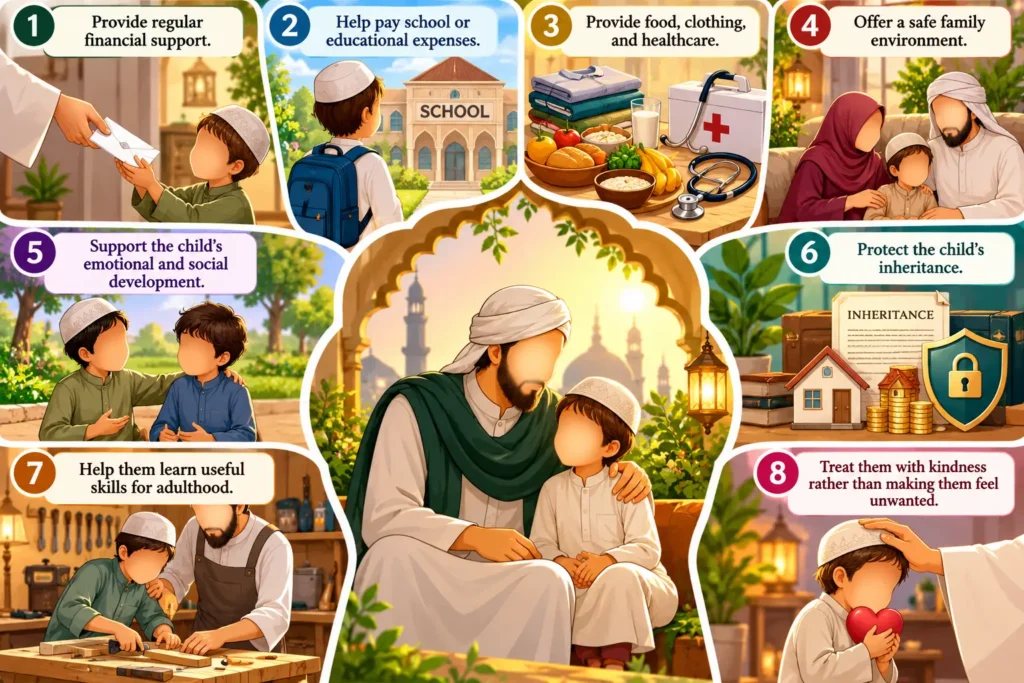
- Provide regular financial support.
- Help pay school or educational expenses.
- Provide food, clothing, and healthcare.
- Offer a safe family environment.
- Support the child’s emotional and social development.
- Protect the child’s inheritance.
- Help them learn useful skills for adulthood.
- Treat them with kindness rather than making them feel unwanted.
The principle is not merely to give money. It is to genuinely contribute to the child’s welfare.
Qur’anic Guidelines for Orphan Care
The Qur’an provides several important rules concerning orphans.
1. Protect Their Property
One of the strongest financial protections appears in Surah An-Nisa.
Allah says:
“And give to the orphans their property and do not substitute worthless things for their good ones, and do not consume their property into your own.”
Qur’an 4:2
This establishes a crucial rule: an orphan’s property belongs to the orphan.
A guardian does not automatically become the owner of the child’s wealth simply because the guardian is managing it.
This could include money, inherited property, investments, land, or other assets belonging to the child.
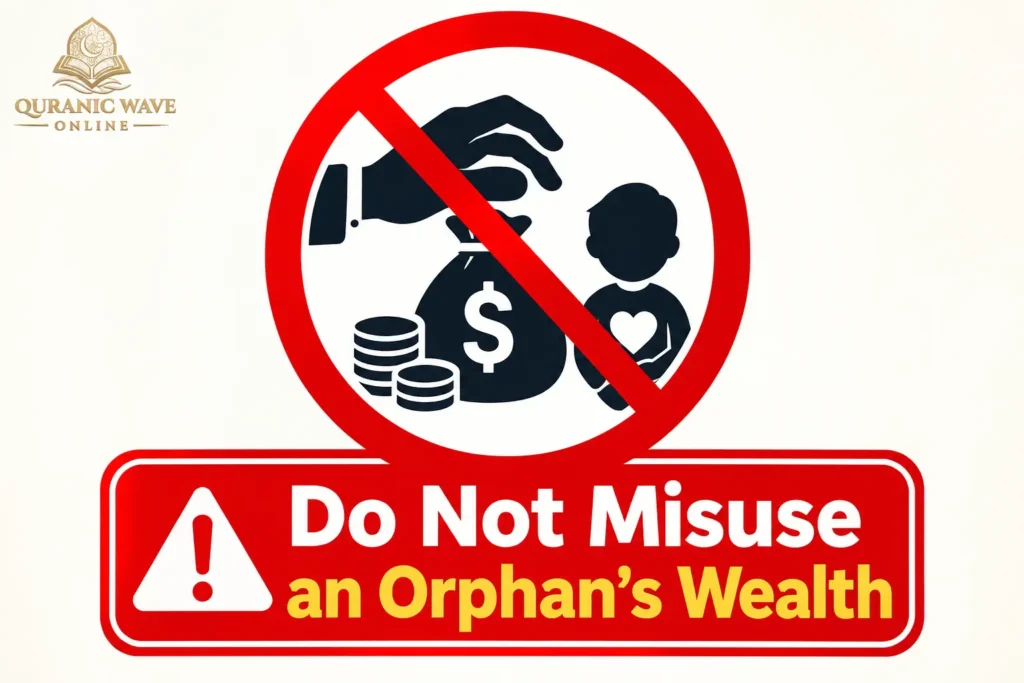
2. Do Not Misuse an Orphan’s Wealth
The warning becomes even stronger in Qur’an 4:10:
“Indeed, those who devour the property of orphans unjustly are only consuming into their bellies fire. And they will be burned in a Blaze.”
This is one of the most serious warnings concerning financial abuse in the Qur’an.
A guardian should therefore keep clear records and avoid mixing personal spending with the orphan’s money in a way that makes ownership unclear.
3. Manage Their Wealth for Their Benefit
Allah says:
“And do not approach the property of an orphan, except in the way that is best, until he reaches maturity.”
Qur’an 17:34
The phrase “in the way that is best” provides an important standard.
Managing an orphan’s wealth should aim at protecting and benefiting the child rather than benefiting the guardian.
For example, legitimate management may involve preserving assets, paying necessary expenses, or making responsible decisions that protect the child’s interests.
When Should an Orphan Receive Their Wealth?
Surah An-Nisa gives detailed guidance.
Allah says:
“And test the orphans until they reach marriageable age. Then if you perceive in them sound judgement, release their property to them.”
Qur’an 4:6
This verse connects the transfer of property with maturity and sound judgment.
It also warns guardians not to consume the wealth quickly in anticipation of the child growing older.
The verse further instructs that a wealthy guardian should refrain from taking compensation from the orphan’s property, while a guardian who is poor may take what is reasonable, according to the verse’s conditions. It also mentions having witnesses when the property is handed over.
A Practical Principle
A responsible guardian should:
- Keep the orphan’s assets identifiable.
- Maintain accurate financial records.
- Avoid unnecessary spending.
- Avoid personal enrichment.
- Protect property from loss.
- Prepare for proper transfer when the child reaches the required maturity and sound judgment.
For specific legal or inheritance situations, qualified Islamic legal advice and applicable local law should also be considered.
Financial Rights of Orphans in Islam
An important point is often misunderstood: being an orphan does not automatically mean that every property around the child becomes theirs.
Instead, an orphan has specific financial rights based on their relationship to the deceased and the source of the property.
1. Right to Inherited Property
If an orphan is an eligible heir of a deceased parent or relative, their prescribed inheritance share must be protected.
Allah says:
“For men is a share of what the parents and close relatives leave, and for women is a share of what the parents and close relatives leave, be it little or much—an obligatory share.”
Qur’an 4:7
Therefore, a guardian cannot simply decide that an orphan should receive less than their lawful inheritance.
Inheritance shares depend on the surviving relatives and the detailed rules of Islamic inheritance law.
2. Right to Their Own Existing Property
If an orphan already owns money, land, savings, gifts, or other lawful assets, those assets remain theirs.
The guardian’s role is to protect and manage them responsibly when necessary.
The Qur’an’s repeated warnings about orphan wealth demonstrate just how seriously this responsibility should be taken.
3. Right to Financial Protection
The orphan should not be treated as an easy target for financial exploitation.
Islamic guidance requires guardians to distinguish between:
| Guardian’s responsibility | Orphan’s right |
|---|---|
| Manage property responsibly | Ownership remains with the orphan |
| Provide necessary care | Receive proper support |
| Protect inherited assets | Receive their lawful inheritance |
| Keep financial records | Knowingly receive their property when mature |
| Avoid personal exploitation | Be protected from financial abuse |
This distinction is essential in understanding the Islamic financial rights of orphans.
Can a Guardian Use an Orphan’s Money?
This is an area where caution is extremely important.
The basic principle is that an orphan’s wealth must not be consumed unjustly.
The Prophet ﷺ was asked about a guardian who was poor and responsible for an orphan. A narration in Sunan Abi Dawud 2872, graded Hasan Sahih by Al-Albani, permits the guardian to use the orphan’s property within strict limits, without extravagance, haste, or treating it as personal wealth.
This should not be understood as permission for unrestricted personal spending.
A guardian should therefore distinguish between:
- Necessary expenses for the orphan
- Legitimate management costs
- Personal expenses
- Unjustified withdrawals
When there is uncertainty, protecting the orphan’s property is the safer approach.
Islam Encourages Emotional and Personal Care
Orphan care is not only about money.
A child can have food and clothing while still feeling lonely, unwanted, or excluded.
The Qur’an says:
“And if you associate with them, they are your brothers.”
Qur’an 2:220
This provides a beautiful reminder that orphan care should not create unnecessary emotional distance.
Children need affection, attention, encouragement, education, and a sense of belonging.
Allah also says:
“So as for the orphan, do not oppress [him].”
Qur’an 93:9
Oppression can involve more than taking money. Humiliation, harsh treatment, neglect, or deliberately making a child feel inferior are also contrary to the spirit of this command.
Orphan Care and Kafalah
Islam strongly encourages caring for children who have lost parental support.
At the same time, Islamic teachings distinguish caring for a child from changing their biological lineage.
The Qur’an says:
“Allah has not made your adopted sons your [true] sons.”
Qur’an 33:4
And Allah says:
“Call them by [the names of] their fathers; it is more just in the sight of Allah.”
Qur’an 33:5
This is why the Islamic concept of kafalah emphasizes protection, upbringing, support, and care while preserving known biological lineage.
Questions about inheritance, guardianship, mahram relationships, and family names can involve detailed fiqh and local law, so individual cases should be discussed with a qualified scholar and, where necessary, a legal professional.
How Can We Support an Orphan Today?
You do not have to become a legal guardian to help an orphan.
Practical forms of support include:
1. Sponsor Education
Help with school fees, books, uniforms, transportation, or vocational training.
2. Provide Regular Food Support
Consistent assistance can be more useful than occasional gifts because it helps families plan.
3. Support Healthcare
Medical treatment, medicines, dental care, and emergency healthcare can make a lasting difference.
4. Give Financial Assistance Responsibly
If donating through an organization, check how the money is managed and whether the organization provides transparent information about its programs.
5. Support Skills and Independence
As children grow older, education and practical skills can help them become financially independent.
6. Treat Them With Dignity
Never make an orphan feel that they are receiving charity because they are less valuable than anyone else.
Common Mistakes to Avoid in Orphan Care
Good intentions are important, but responsible care also requires knowledge.
Avoid:
- Using an orphan’s inheritance for personal luxury.
- Mixing their money with yours without proper records.
- Delaying the return of their property without a valid reason.
- Publicly humiliating children because they receive charity.
- Treating orphan care as only a financial transaction.
- Making promises that cannot be fulfilled.
- Ignoring education and emotional development.
- Assuming that every orphan automatically inherits from every guardian.
- Changing or concealing a child’s known lineage.
The Qur’an specifically reminds guardians to fear Allah and speak with justice when dealing with vulnerable children and their property.
A Simple Islamic Orphan-Care Checklist
If you are responsible for an orphan, this checklist can help:
Daily and personal care
- Provide safety and affection.
- Listen to the child.
- Encourage education.
- Protect their dignity.
Financial care
- Identify all assets belonging to the child.
- Keep records.
- Separate personal and orphan expenses.
- Protect inherited property.
- Avoid unnecessary withdrawals.
Future planning
- Monitor education and skills.
- Prepare the child for financial independence.
- Transfer their property when the Qur’anic conditions of maturity and sound judgment are fulfilled.
- Obtain appropriate witnesses and documentation where required.
Frequently Asked Questions About Orphan Care in Islam
What is the reward for caring for an orphan in Islam?
The Prophet Muhammad ﷺ said that he and the person who looks after an orphan will be together in Paradise like his index and middle fingers. This is recorded in Sahih al-Bukhari 5304 and a similar narration is found in Sahih Muslim 2983.
Does an orphan have financial rights in Islam?
Yes. If an orphan owns property or is entitled to inheritance, that wealth must be protected. Qur’an 4:2, 4:6, 4:7, 4:10, and 17:34 provide important guidance concerning orphan property and inheritance.
Can a guardian take an orphan’s money?
A guardian cannot simply take an orphan’s wealth for personal use. The Qur’an strongly prohibits unjust consumption of orphan property. Specific allowances for a poor guardian are discussed in Sunan Abi Dawud 2872 and are subject to strict conditions.
Does every orphan automatically inherit money?
No. Inheritance depends on the deceased person’s relationship to the child and the rules of Islamic inheritance. Orphanhood itself does not make a child an heir to every person who cares for them. Qur’an 4:7 establishes obligatory inheritance shares for eligible heirs.
Is orphan care only about giving money?
No. Islamic orphan care includes protecting the child’s property and dignity, providing proper care, supporting education and development, and treating the child with kindness. Qur’an 2:220 emphasizes improving the condition of orphans.
Can Muslims adopt an orphan?
Muslims can care for and raise an orphan, and Islam strongly encourages caring for vulnerable children. However, Qur’an 33:4–5 distinguishes caregiving from changing a child’s established biological lineage. Specific family, inheritance, and mahram questions require careful application of Islamic rulings.
Conclusion
Caring for an orphan is a sacred amanah—a trust that demands love, dignity, and absolute financial integrity.
For me, the main takeaway is that orphan care goes far beyond financial charity; it is about protecting a child’s future and safeguarding their rights.
If you are in a position to help, start with a single practical step today, whether by supporting a child’s education or assisting a family in your community. Every act of care brings us closer to fulfilling this vital Islamic duty.
For more Islamic guidance on family, vows, and traditions, explore our guides on:
Limits for Mahram Relatives in Islam