
Raising Muslim children in the West can bring unique questions for parents. Children may grow up surrounded by ideas, habits, celebrations, entertainment, and social expectations that are different from those practiced at home.
The goal of Islamic parenting is not to make children feel that Islam is a burden or that they must reject everyone around them. It is to help them know who they are, why they believe, and how to live Islam with confidence, kindness, and wisdom.
For me, one of the most important principles is simple: children learn Islam not only from what parents teach, but from what they see every day.
What Does Islam Say About Parenting?
Islam places a serious responsibility on parents to care for their children’s faith, character, and wellbeing.
Allah says:
“O believers! Protect yourselves and your families from a Fire…”
— Qur’an 66:6
This responsibility includes teaching children about Allah, worship, good manners, right and wrong, and how to make thoughtful choices.
Allah also says:
“And enjoin prayer upon your family and be steadfast therein.”
— Qur’an 20:132
The Prophet Muhammad ﷺ also described responsibility within the family as a trust. He said:
“All of you are shepherds and each of you is responsible for his flock.”
— Sahih al-Bukhari 7138
Islamic parenting, therefore, is more than correcting mistakes. It is building a home where faith can grow.
1. Make Allah Known Through Love
Young children should first experience Islam as something connected with love, safety, gratitude, and hope.
Talk naturally about Allah when something good happens:
- “Allah gave us this beautiful day.”
- “Let’s thank Allah for our food.”
- “Allah loves kindness.”
- “Let’s ask Allah to help us.”
Instead of making every conversation about punishment, teach children that Allah is the One who created them, provides for them, hears their duas, and gives them opportunities to repent.
As children grow older, introduce concepts such as accountability, Paradise, Hellfire, halal, haram, and the purpose of worship according to their age and understanding.
For more Islamic guidance on family, vows, and traditions, explore our guides on:
Limits for Mahram Relatives in Islam
How to Pay Kaffarah for Breaking an Oath
2. Let Children See Islam at Home
Children notice what parents actually do.
If salah is treated as an interruption, children may develop the same attitude. If parents stop for prayer, make dua, read Quran, speak respectfully, and show gratitude, these actions become part of normal family life.
Create simple routines such as:
| Family Routine | Islamic Habit |
|---|---|
| Morning | Short dhikr and dua |
| Before school | Bismillah and a personal dua |
| Mealtime | Bismillah and gratitude |
| Evening | Quran or Islamic story |
| Prayer time | Pray together when possible |
| Before sleeping | Bedtime adhkar |
Consistency matters more than creating a perfect schedule.
3. Teach Salah Gradually
Prayer should become familiar before it becomes difficult.
A young child can begin by watching parents make wudu, standing beside them, learning simple movements, and memorizing short surahs.
The Prophet ﷺ instructed parents to command children to pray at seven.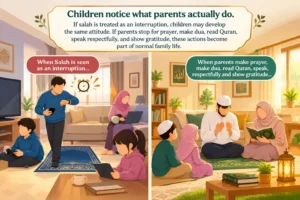
Parents should also teach prayer with patience. If a child struggles with a surah or forgets a movement, correction should be calm and age-appropriate.
A child who associates salah with encouragement and family connection may find it easier to maintain as they mature.
4. Teach Children How to Live as Muslims in Western Society
Muslim children living in Western countries may attend schools with classmates from many religions and backgrounds.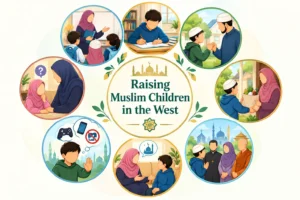
Teach them that being Muslim does not mean being rude, isolated, or disrespectful.
They can learn to:
- Respect teachers and classmates.
- Be honest in schoolwork.
- Keep promises.
- Help neighbors.
- Avoid mocking other religions.
- Explain their beliefs politely.
- Know which activities conflict with Islamic teachings.
- Ask parents questions without fear.
A child should be able to say, “I am Muslim,” without feeling ashamed, while also learning how to treat people who believe differently with fairness and good character.
5. Build Islamic Identity Without Creating Fear
Islamic identity develops through knowledge and belonging.
Make space for:
- Eid celebrations.
- Family Quran time.
- Islamic books and stories.
- Halal family activities.
- Visits to the mosque.
- Muslim friendships.
- Community events.
- Stories of the Prophets and Companions.
Children need positive memories connected to their faith.
If every Islamic conversation becomes a warning, they may hear Islam mainly as a list of restrictions. Instead, explain the wisdom behind rules whenever appropriate.
6. Deal With Difficult Questions Honestly
Children growing up in the West may eventually ask questions about dating, clothing, alcohol, relationships, gender, religion, social media, or why Muslims follow particular rules.
Do not panic when difficult questions appear.
A question is not necessarily rebellion.
Try saying:
“That is a good question. Let’s understand it together.”
If you do not know the answer, say so and find a reliable Islamic source or qualified scholar.
This builds trust. Children should know that coming to their parents with a difficult question is safer than searching secretly for answers elsewhere.
7. Use the Prophetic Model of Mercy
One beautiful example comes from the life of the Prophet ﷺ.
Abu Hurayrah رضي الله عنه narrated that the Prophet ﷺ kissed his grandson Al-Hasan. A man mentioned that he had ten children but had never kissed any of them. The Prophet ﷺ responded:
“Whoever does not show mercy will not be treated mercifully.”
— Sahih al-Bukhari 5997
This is an important lesson for parents.
Discipline and boundaries have a place, but affection should not disappear from the home.
Hug your children. Listen to them. Notice their achievements. Comfort them when they fail.
A child needs to know that being corrected does not mean being rejected.
8. Teach Digital and Social Media Responsibility
For many Muslim families in the West, parenting now includes guiding children through smartphones, games, YouTube, social media, and online friendships.
Rather than relying only on secret monitoring, gradually teach children:
- Protect personal information.
- Avoid inappropriate content.
- Do not communicate privately with strangers.
- Never forward harmful or embarrassing material.
- Remember that online actions also have consequences.
- Come to a parent when something online makes them uncomfortable.
Create reasonable family rules about screen time, bedrooms, devices, and age-appropriate content.
9. A Small Lesson From the Companions
The Companions رضي الله عنهم did not treat young people as unimportant.
Young companions were taught, trusted, and included according to their abilities. One famous example is Ibn Abbas رضي الله عنهما, who was young but became known for his knowledge of the Quran and Sunnah.
The lesson for parents is not to expect adult behavior from children. It is to give children opportunities to learn, ask, participate, and gradually take responsibility.
10. What Should Parents Do When a Child Makes a Mistake?
Avoid turning one mistake into a permanent identity.
Instead of:
“You are a bad child.”
Try:
“That action was wrong. Let’s talk about what happened and how you can fix it.”
Teach children to:
- Admit mistakes.
- Apologize.
- Make tawbah.
- Repair harm.
- Learn from consequences.
- Try again.
Islam teaches accountability, but it also teaches repentance and hope.
Practical Islamic Parenting Checklist
Parents can regularly ask themselves:
- Does my child know why we are Muslim?
- Does my child feel comfortable asking me religious questions?
- Do we pray together?
- Is Quran part of our home?
- Do I demonstrate the character I expect?
- Does my child have good Muslim friends?
- Have we discussed online safety?
- Can my child explain Islamic values respectfully?
- Do I show affection and mercy?
- Am I listening before correcting?
You do not need to become a perfect parent before beginning.
Start with one meaningful change and build from there.
Frequently Asked Questions
How can I raise Muslim children in the West?
Build a strong Islamic home environment through salah, Quran, dua, Islamic learning, good character, family connection, and positive Muslim community involvement. Teach children how to participate respectfully in wider society while remaining confident in their Islamic identity.
How do I keep my child connected to Islam?
Make Islam part of everyday family life rather than limiting it to weekend classes. Pray together, tell Islamic stories, celebrate Eid, answer questions, visit the mosque, and allow children to experience Islam as both worship and a way of life.
How should Muslim parents handle peer pressure?
Listen first and avoid immediately criticizing the child. Discuss the situation, explain Islamic principles, practice possible responses together, and help the child develop confidence to make responsible decisions.
Should parents be strict with Muslim children?
Children need boundaries, but Islamic parenting also emphasizes mercy, patience, teaching, and good example. Discipline should be thoughtful, age-appropriate, and aimed at teaching rather than humiliating the child.
What is the most important part of Islamic parenting?
Build the child’s relationship with Allah while developing good character. Knowledge, worship, family connection, and practical guidance work together.
Final Thoughts
Raising Muslim children in the West is a responsibility, but it can also become a beautiful journey for the whole family. Parents do not have to shield children from every difference around them. They can teach them how to recognize Islamic values, make thoughtful choices, respect others, and remain connected to Allah.
The strongest lessons often happen in ordinary moments: praying together, answering a difficult question, saying Bismillah before eating, listening after a bad day, or showing mercy when a child makes a mistake.
Start where your family is today. Choose one habit, strengthen one conversation, and make your home a place where children can learn about Islam with knowledge, love, confidence, and trust.
For more simple Islamic learning resources, QuranicWave can help your family continue learning Quran, duas, and authentic Islamic guidance together.